The Advisor Effect: How Training 14 Coaches Could Launch Hundreds of Community Businesses in Post-Conflict South Sudan
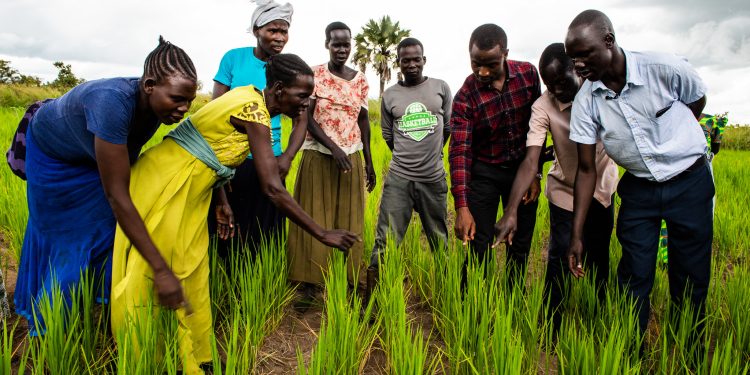
When a cooperative in rural South Sudan struggles to keep basic financial records, negotiate a fair price with a buyer, or decide whether to reinvest its earnings, the person best placed to help is rarely a donor or a distant policy. It is the local agribusiness advisor who visits the group, understands its context, and can translate business principles into practical next steps. A training held at the University of Juba in November 2025 was built around exactly that insight — and offers a compelling case for why capacity-building efforts aimed at community-level enterprise should start with the advisors, not just the enterprises.
Under the Climate Resilient Agri-Food Systems Transformation Program – Project 1 (CRAFT-1), RUFORUM and the Food and Agriculture Organization trained 14 agribusiness advisors (seven women and seven men), drawn from Central Equatoria, Eastern Equatoria, Jonglei and Northern Bahr el Ghazal states; in agribusiness planning, marketing, financial literacy and business model design, alongside the rice, sorghum and fish value chains that anchor much of the region’s rural economy.
Why the Advisor, Not the Business, Is the Right Entry Point
Community-level businesses; farmer cooperatives, producer organizations, small agro-processing ventures rarely fail for lack of ambition or effort. They fail more often because no one nearby has the specific combination of skills to guide them: how to structure a business plan, read a balance sheet, price a product for a real market, or manage the tension between distributing profits and reinvesting them. Training a single advisor to hold that combination of skills creates a multiplier effect that a one-off grant or a single cooperative’s internal effort cannot replicate; one trained advisor can carry these tools to dozens of community groups across a county, long after any individual training programme has ended.
This logic shaped the training’s curriculum directly. Advisors worked through modules on agribusiness planning and value chain analysis, marketing and digital tools, and critically for community enterprise the formation and governance of Village Savings and Loan Associations (VSLAs), business model canvases, and the mechanics of accessing the FAO Loan Scheme. These are the specific building blocks a community group needs to move from an informal gathering of farmers to a functioning, bankable business.
Evidence the Approach Is Landing
Participant evaluations lend credibility to the model: 93% of the 14 advisors said they would recommend the training, and 79% rated it excellent, with particular praise for its relevance and its practical, hands-on business-planning components. Advisors reported leaving with concrete new skills in business model development, digital marketing and market linkages, and financial record-keeping and a strong stated intention to apply these directly within the cooperative leadership and producer organizations they support.
Honest About the Constraints Ahead
The training’s design did not shy away from the obstacles advisors will face translating new skills into functioning community businesses. Participants themselves flagged limited financial capital, macroeconomic instability and price fluctuation, and inadequate agro-processing infrastructure such as the absence of rice mills as constraints that no amount of advisory coaching alone can resolve. Facilitators also had to navigate variability in participants’ prior technical knowledge, language barriers across South Sudan’s multilingual regions, and limited access to demonstration sites and digital tools during the training itself.
What Advisors Are Asking For Next
Rather than treating the training as complete, participants pushed for its continuation and deepening: extending the financial-literacy and business-planning modules to allow more practical exercises, adding value-chain-specific content on modern planting methods and processing machinery, running refresher courses at least annually to sustain producer organizations, and building institutional partnerships to close the agro-processing infrastructure gap. Each recommendation reinforces the same underlying argument that supporting community-level business creation is not a single intervention but an ongoing coaching relationship, and the advisor is the fixed point around which that relationship is built.
For a country working to move its agricultural sector from subsistence toward genuine market participation, the case emerging from Juba is straightforward: fund the advisor, and the advisor will carry that investment into every cooperative, producer group and community enterprise they touch.