How Elvin Saline is transforming Kendu Bay kitchens

By Branice Nafule, Communication and Creative Officer for TAGDev 2.0 at the University of Eldoret, Kenya
When a woman is given the tools and space to build, she does not just construct a business, she builds a foundation that lifts an entire community.
In Kendu Bay, Kenya, the early morning air is shifting. The dense, irritating smoke that once choked local kitchens, leaving families coughing and stinging from the fumes, is being replaced by the efficient, clean heat of specialized, energy-saving jikos (cookstoves). Behind this quite innovation is Elvin Saline, a young, passionate lady who pours her entire heart into everything she does. Armed with a diploma in civil engineering, Elvin is on a mission to completely shatter the long-standing belief that women cannot thrive in heavy, technical fields, by introducing new innovations in her community.
Her journey from a frustrated, idle graduate to an active community entrepreneur is a powerful masterclass in resilience.
After proudly earning her diploma in civil engineering, Elvin found herself caught in a trap familiar to many young African graduates, she was home bound, unemployed, and doing nothing productive after school.
Rather than dwelling on the challenges she faced, Elvin turned her attention to the world around her. Guided by her engineering background, she began to see everyday community experiences through the lens of innovation. She noticed that many households were spending an increasing share of their income on firewood as prices continued to rise. In many families, children also played their part by helping to collect firewood, a long-standing household responsibility in many African communities. While this contribution is part of daily family life, it often meant less time for other activities. These realities presented an opportunity to create a cleaner, more affordable cooking solution that could ease the burden on families while respecting their way of life.
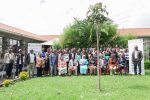
In April 2026, Elvin attended a training organized by Agri Pro Solutions Agroecological Service Providers Hub in partnership with the Transforming African Agricultural Universities to Meaningfully Contribute to Africa’s Growth and Development ( TAGDev 2.0) programme at the University of Eldoret. The training equipped her with entrepreneurship and business development skills, helping refine her innovation to scale and meet her community needs.
Inspired by what she learned, she combined her engineering background with the practical skills she gained from the training and launched a business constructing energy-efficient, enclosed jikos. Using locally available materials such as bricks, sand, cement, and red oxide, she began building durable stoves designed to serve households for many years.
“I just wanted to break the belief that there is some extent women can’t go, or some things they can’t do,” Elvin says, her voice ringing with conviction. “We are capable.”
Elvin’s engineered jikos are not just stoves; they are highly efficient economic assets meticulously designed to tackle poverty and danger simultaneously. They aid in massive resource savings, they require limited or few pieces of firewood to generate immense heat. To eliminate kitchen hazards, Elvin’s clever design addresses this head-on by creating a completely enclosed structure. The only exposed opening is a dedicated space perfectly fitted to place a pot or sufuria. By trapping the fire, the jiko completely eliminates common kitchen accidents, such as being severely burnt by stray embers or tripping over shifting firewood and causing personal or structural damage.
Stepping into a heavily male-dominated construction field meant Elvin had to build a thick skin. People openly doubted that a young woman could handle the physical and technical demands of masonry.
“Since the community members are not used to seeing women engaged in this area of work, it has been difficult and challenging to market my work, services, and gain trust from potential customers,” Elvin reflects openly.
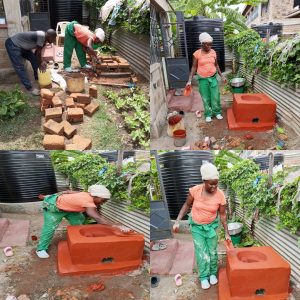
The absolute turning point came when she finally secured her very first customer. Knowing that the stakes were incredibly high, Elvin poured her engineering precision into that first build. The flawless completion of that single stove transformed it from a household appliance into an undeniable, living moment of her talent.
“The first customer that gave me the opportunity was a major breakthrough because their completed stoves or jikos provided evidence of my skills and helped me build credibility,” Elvin explains. “I now use these examples to demonstrate my ability to deliver quality work. As women in this field, we have to consistently produce high quality work to challenge existing perceptions and prove we are equally capable.”
To break down financial barriers and make her innovation accessible to even the poorest families, Elvin designed a highly flexible, practical business model. If a farmer or customer has their own construction materials readily available, Elvin gladly maneuvers around the financial constraints by asking for labor payment only. This keeps her overhead low and her operations lightning-fast, she simply shows up to the site carrying her trowel, brush, and steel, ready to work. Through this sheer grit and commercial agility, she has already successfully constructed eight (8) jikos so far, worth KES 28,000, and currently has four (4) more bookings yet to be completed.
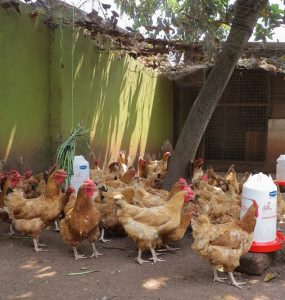
Building these jikos has completely transformed Elvin’s own livelihood. Instead of relying on a single stream of income, she strategically reinvested the money earned from her masonry work and savings to buy three hundred (300) chickens, launching a thriving poultry enterprise. This brilliant economic buffering keeps her highly productive and financially secure even during the brief windows when she is waiting for more construction bookings to roll in. From this, she sells the chicken on maturity at Ksh 1000. Her life is night-and-day compared to those empty days after graduation when she had nothing productive to do.
But Elvin refused to be the only success story in Kendu Bay. Recognizing that true empowerment means pulling others up, she has actively trained and mentored two (2) other young ladies in her locality in the tricky art of jiko building. Today, those very ladies are running their own builds, performing exceptionally well, making cooking an enjoyable and effective experience across Kenyan households, and driving massive positive impact throughout her community.
Despite the heavy challenges, the initial isolation, and the biting criticism of the traditionalists, Elvin displays pure joy and fulfillment regarding what she does. She has absolutely no plans to stop. Instead, she is sharpening her skills to become even more consistent and perfect, with immediate plans to formally register her enterprise on the market for future massive expansion. Her ultimate goal is to completely flip the societal narrative on its head and recruit as many women as possible into this field of work, shifting the focus away from initial struggles and highlighting the profound strength built along the way.
“Women or girls given a good and conducive environment can implement great ideas and create opportunities ,” Elvin says proudly, standing tall against negative feedback. “Worrying about judgement is a normal, but that should not stop them from taking the necessary steps towards empowerment.”
Elvin Saline’s journey exemplifies the vision of the TAGDev 2.0 programme: empowering young people, particularly women, to become job creators, innovators, and agents of positive change within their communities. Through determination, technical expertise, and entrepreneurial training, she is not only transforming kitchens in Kendu Bay but also inspiring a new generation of women to build their own futures.
Find more impactful stories from the University of Eldoret, kenya under the TAGDev 2.0 programme, here