Future Implications and Sustainability of Transforming African Agricultural Universities to Meaningfully Contribute to Africa’s Growth and Development (TAGDev 2.0) Project
Stephen Onakuse
Department of Food Business and Development
Cork University Business School
University College Cork, Ireland
Introduction
The Transforming African Agricultural Universities to Meaningfully Contribute to Africa’s Growth and Development (TAGDev) Project represents an important intervention in addressing the challenges facing agricultural education, youth unemployment, food insecurity, and climate change in Africa. The programme, implemented through partnerships involving the Regional Universities Forum for Capacity Building in Agriculture (RUFORUM), the Mastercard Foundation, the Global Confederation of Higher Education Associations for Agricultural and Life Sciences (GCHERA), and participating African universities, seeks to strengthen universities and Technical and Vocational Education and Training (TVET) institutions while equipping young people with practical, entrepreneurial and agricultural skills. TAGDev 2.0, which runs from 2023 to 2033 (RUFORUM, 2023), places particular emphasis on inclusive employment opportunities, climate-adaptive agricultural production, quality agricultural education, entrepreneurship and innovation.
The future implications of the TAGDev Project are significant. It has the potential to transform agricultural education, stimulate youth employment, strengthen food systems, promote climate-smart agriculture and increase the contribution of universities to community development. However, its long-term sustainability will depend on institutional ownership, diversified funding, government support, private-sector partnerships, continuous curriculum development, monitoring and evaluation, and the ability of beneficiaries and institutions to continue TAGDev activities after external project funding ends. This review examines the future implications and proposes strategies for ensuring the sustainability and long-term impact of the programme (RUFORUM, 2023).
Agriculture remains central to Africa’s economic and social development. It provides employment and livelihoods for millions of people and plays an important role in food security, rural development and poverty reduction (ADB, 2024, 2026). Nevertheless, African agricultural systems face major challenges, including youth involvement, climate change, limited access to technology, inadequate agricultural infrastructure, unemployment among young people, weak value chains and little or no links between higher education, the private sector and the agricultural sector.
African universities agricultural education has been criticised for emphasising theoretical knowledge without sufficiently preparing graduates for practical agricultural production, modernisation of agricultural curricula that aligns with Africa growth and development, entrepreneurship and employment. TAGDev was partly developed in response to these challenges. Its approach emphasises experiential learning, entrepreneurship, community engagement, industrial engagement and stronger relationships between universities, farmers, businesses and other agricultural stakeholders. Evidence from the earlier TAGDev programme indicates that the initiative promoted practical-oriented graduates and strengthened connections between students, farmers, private-sector organisations and communities (RUFORUM, 2023).
TAGDev 2.0 builds on this foundation by expanding its geographical and institutional scope and emphasising inclusive, equitable and climate-resilient transformation of agriculture and agri-food systems that meets the needs of today and the future.
Currently, TAGDev 2.0 (2023–2033) is implemented in partnership with fifteen universities across Africa: Gulu University and Uganda Martyrs University (Uganda); University of Eldoret and Egerton University (Kenya); University of Cape Coast (Ghana); National University of Agriculture (Benin); University of Bamenda (Cameroon); University of the Free State (South Africa); University of Port Harcourt (Nigeria); Malawi University of Science and Technology (Malawi); Mohamed VI Polytechnic University (Morocco); Africa University (Zimbabwe); Sokoine University of Agriculture (Tanzania); Haramaya University (Ethiopia); and Université du Sine Saloum El-Hâdj Ibrahima Niass (USSEIN) (Senegal).
Transformation of Agricultural Education
One of the most important future implications of TAGDev is the transformation of agricultural education in African universities and TVET institutions. The programme promotes education that goes beyond classroom learning by incorporating experiential learning, entrepreneurship, innovation and community engagement, but fall short of curriculum changes. This approach could lead to agricultural universities producing graduates who are not only qualified for conventional employment but are also not capable of creating businesses, developing agricultural technologies and solving problems within their communities.
Agricultural education provides students with the knowledge and skills required to understand modern farming practices, agricultural technologies, natural resource management, and agribusiness. Traditionally, many small-scale African farmers have deepened on knowledge passed from one generation to another. Although, indigenous knowledge remains valuable, changing environmental and economic conditions require a trained generation armed with additional skills and information to lead and sustain the future of food production, processing and other stakeholders along the value chain.
Therefore, the transformation of African agriculture increasingly depends on the adoption of modern technologies. Training new generation farmers to understand technologies such as mobile agricultural applications, precision farming, improved irrigation systems, mechanized equipment, weather information services, and digital marketplaces.
Digital training can also connect farmers with information about market prices, financial services, weather conditions, and agricultural inputs. This reduces information gaps and enables farmers to make better decisions. However, technology is only useful when people have the knowledge and confidence to use it effectively. Therefore, digital literacy should form an important part of agricultural education.
The long-term implication is the continued view of agriculture as other subject areas, which do not readily create pathways to formal employment, rather than seeing it as a platform for innovation, enterprise development and community transformation.
Increased Youth Employment and Entrepreneurship
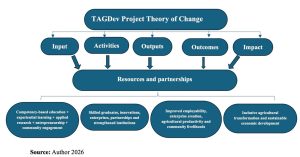
Youth unemployment remains a major development challenge in Africa. TAGDev, is designed to address the increased youth employment and entrepreneurship challenges by equipping young women and men with skills relevant to agriculture, agribusiness and entrepreneurship. Its programme outcomes specifically include expanding work and livelihood opportunities for young people.
It will be accurate to posit that increasing youth participation in agricultural development through TAGDev, will help change the perception of farming from a low-income occupation to a modern business and professional opportunity. The change on perception can attract educated young people into agriculture and contribute to a more skilled and innovative agricultural workforce.
The future impact of the TAGDev project could extend beyond direct beneficiaries. A graduate who establishes an agribusiness may employ other young people, purchase products from farmers and create markets for agricultural inputs and services (RUFORUM, 2023). Consequently, TAGDev can generate a multiplier effect across local farming communities, regions and global.
For this impact to be sustained, however, entrepreneurship training must be accompanied by sound and modernised curriculum that meets the needs of today and future agricultural generations, ably backed with access to finance, government policies, mentorship, private sectors collaboration, organised markets, technology and business development services familiar with agriculture value chains.
While many young Africans are attracted to employment opportunities outside agriculture partly because farming is sometimes perceived as low-income and traditional, it raises questions as to how the implementation of TAGDev 2.0 can further debunk the notion that agriculture is a low-income business.
While training alone cannot change this perception, the broader space of TAGDev 2.0 activities by practice, will help retain and focus agricultural graduates to agribusiness, agricultural technology, food processing, marketing, agricultural finance, and entrepreneurship, with appropriate support, that makes agriculture an attractive source of employment and innovation.
How can the TAGDev 2.0 project ensure an inclusion outside the walls of universities, taking into account that rural women can benefit greatly from agricultural training in third level education? Providing rural women with access to technical knowledge, financial education, leadership skills, and entrepreneurship training can increase TAGDev 2.0 reach, thereby increasing women productivity and economic independence. Because women play major roles in food production and household nutrition in many African communities, investing in their agricultural education can have wider benefits for families and communities.
Overall, increased youth employment and entrepreneurship can transform African agriculture from a largely subsistence-oriented sector into a more productive, innovative, commercially oriented, and employment-generating industry.
Promotion of Climate-Smart Agriculture and Strengthening Food Security
Increased youth employment and entrepreneurship in African agriculture can have major economic, social, and food-security benefits.
Greater youth participation creates employment not only on farms but throughout the agricultural value chain such as processing, transportation, storage, marketing, packaging, agricultural services, and digital agriculture. This helps reduce youth unemployment and increases household incomes.
For example, the African Development Bank reports that its ENABLE Youth projects had created more than 237,000 jobs across 18 African countries, following about $669 million in investment (ADB, 2026).
Climate change is increasingly affecting agricultural productivity through changes in rainfall patterns, droughts, flooding, pests, diseases and land degradation. TAGDev 2.0 explicitly identifies climate adaptation and climate-resilient agriculture as major objectives. However, a more skilled agricultural workforce, improved agricultural technologies and stronger value chains can contribute to food security (RUFORUM, 2023). TAGDev’s emphasis on climate-adaptive production, entrepreneurship and agricultural innovation creates opportunities to improve the efficiency and resilience of food production systems.
The future implication is that farmers and agricultural professionals trained through the TAGDev’s may increasingly adopt climate-smart technologies and management practices. This can contribute to improved productivity while reducing vulnerability to climate-related shocks. In Nigeria, for example, the University of Port Harcourt’s TAGDev 2.0 programme focuses on the rice value chain and includes climate-smart agriculture, farmer capacity building and job creation (RUFORUM, 2023). Recent programme activities have included training farmers in climate-smart rice production.
Another example is Haramaya University, which focus on strengthening the advanced research knowledge and methodological competencies required by PhD students to design rigorous studies, analyse research data and produce high-quality scholarly outputs (TAGDev 2.0, Haramaya University, 2026).
The younger generation are often well positioned to adopt digital technologies and new business models. Therefore, their involvement can accelerate the use of mobile finance, digital marketplaces, precision agriculture, improved machinery, climate-smart farming, and data-driven decision-making.
However, the positive impact expected from TAGDev 2.0 is not automatic. Young African agripreneurs commonly face barriers including: limited access to affordable finance and credit, difficulty accessing land, inadequate infrastructure and unreliable electricity, limited technical and business skills, weak market linkages. climate change and environmental risks, limited access to modern technologies and negative perceptions of farming among some young people.
The African Development Bank therefore emphasises that youth programmes need to combine finance, skills development, technology, incubation, and market access, rather than relying on training alone (ADB, 2024).
In the long term, successful implementation of the TAGDev’s project could contribute to greater availability of food, reduced post-harvest losses, improved processing and stronger connections between producers and markets. TAGDev activities in Nigeria already illustrate this broader value-chain approach, including support for agro-processors to improve compliance and market competitiveness.
TAGDev build stronger University and Community Relationships
Another important implication of the TAGDev’s project is the possibility of changing the traditional relationship between universities and surrounding industries and communities. Instead of universities functioning primarily as institutions for teaching and research, TAGDev encourages them to become active partners in solving community and agricultural problems.
Community action research (CAR) and community-based organisations (CBOs) models can enable students, lecturers/researchers, farmers and other stakeholders across the value chain to work together to identify problems and develop locally appropriate solutions (Onakuse, 2022). This model can improve the relevance of university research while giving students practical experience.
TAGDev 2.0 emphasis on inclusion and equitable access to opportunities for young people, particularly the participation of women, the custodian of traditional processing methods, has an important future implications for gender equality and social inclusion on the one hand, it will also engage disadvantaged groups in agricultural education, entrepreneurship and leadership, to diversify the agricultural workforce and expand economic opportunities.
Over time, stronger university community relationships could make agricultural universities important centres for rural innovation and development. The process, will enable equal access to mentorship, finance, technology, markets and leadership opportunities.
Sustainability of the TAGDev Project
The sustainability of TAGDev will depend largely on whether participating universities integrate successful programme practices into their permanent academic and institutional systems, especially in the curriculum. Also, universities should incorporate experiential learning, entrepreneurship education, community engagement and agricultural innovation into their regular curricula rather than treating them as temporary teaching programme from other departments.
Long-term financial sustainability is one of the major challenges facing development projects across the world. TAGDev has benefited from partnerships involving organizations such as the Mastercard Foundation and RUFORUM. Stronger university industry partnerships can also ensure that academic programmes remain responsive to changes in agricultural technology and labour-market requirements.
Institutional ownership of the specific goals of TAGDev is particularly important because external donor funding is time-bound. By embedding TAGDev approaches into university policies, curricula and budgets, institutions can continue the programme’s legacy after the formal project period.
However, continued impact requires diversification of funding sources. Universities and programme partners should explore government funding, private-sector investment, research grants, alumni contributions, competitive innovation funds and revenue generated from university enterprises. Agricultural innovation centres and business incubators could also generate income while supporting student and graduate enterprises.
Entrepreneurship is one important mechanism for sustaining TAGDev outcomes. Instead of beneficiaries remaining dependent on grants, TAGDev can develop and support viable businesses that generate income, employment and community services. This requires strengthening the connection between training and actual business opportunities. Students entrepreneurs need access to finance, appropriate technologies, market information, business networks and mentorship with emphasis on commercialisation of innovations generated through the TAGDev project (RUFORUM, 2023).
The private sector partnership should play a greater role in sustaining TAGDev outcomes, while agricultural businesses provide internships, employment, mentorship, technical support, markets and investment opportunities for students and graduates.
Monitoring, Evaluation and Knowledge Management sustainability
Sustainability requires continuous evidence of what works across the different TAGDev implementing institutions. TAGDev hosting institutions should maintain strong systems for monitoring graduate employment, enterprise survival, farmer productivity, adoption of climate-smart practices, gender inclusion, income changes and community-level impacts.
TAGDev’s future success should not be measured only by the number of graduates trained or businesses created. Agricultural activities supported through the TAGDev programme should promote sustainable initiatives such as soil management, efficient water use, biodiversity conservation, responsible input use, climate adaptation and reduction of agricultural waste. Integrating environmental sustainability into agricultural education enable the production of graduates capable of balancing economic productivity with innovations.
It is imperative that lessons from successful and unsuccessful interventions through TAGDev project should be documented and shared among participating universities to compare what works and the room for improvement for future replication across countries and agricultural value chains.
Challenges to Long-Term TAGDev Sustainability
Despite TAGDev potentials, TAGDev may face several challenges. These include dependence on external funding, inadequate infrastructure, limited access to agricultural finance for agripreneurs, weak market systems, political and economic instability, climate shocks and difficulties in maintaining partnerships after project funding ends.
There is also the risk that successful pilot interventions may not be scaled sufficiently. Therefore, sustainability requires moving from isolated project activities to institutional and national systems to ensure that trained graduates remain connected to agricultural value chains as training alone cannot guarantee employment or business success if graduates lack access to finance, land, markets, technology and supportive policies.
Recommendations
To strengthen the future sustainability of TAGDev, it must be institutionalised by incorporating experiential learning, entrepreneurship and community engagement into university curricula and policies. Institutionalisation alone is not enough, as funding must be diversified to establish long-term financing mechanisms.
It is highly critical that university/industry partnerships must to strengthened to provide internships, employment pathways, mentorship and markets. Most importantly, the expansion of access to finance for graduates and young agricultural entrepreneurs through partnerships with financial institutions and investment organizations should be ensured to increase investment in climate-smart agriculture and ensure that climate adaptation becomes a permanent component of agricultural education.
Improve monitoring and evaluation and strengthen government involvement must work hand-in-hand to track long-term outcomes of graduates, enterprises, farmers and communities, so that successful TAGDev approaches can influence agricultural education, youth employment and climate-resilience policies.
Conclusion
To conclude, the TAGDev Project has the potential to make a lasting contribution to Africa’s agricultural transformation. Its emphasis on practical education, entrepreneurship, youth empowerment, climate resilience, innovation and community engagement provides an alternative to traditional approaches to agricultural education and agripreneurs development.
TAGDev 2.0’s 2023–2033 framework continue to provide an opportunity to scale up the different agricultural interventions across a wider network of African agricultural offering universities and agricultural value chains. The future implications of the TAGDev project should continue to include increased youth employment, stronger agricultural institutions, improved food security, greater innovation and more climate-resilient agricultural communities.
Nevertheless, the long-term success of the project will depend on what happens beyond the period of external support. Sustainability requires universities, governments (Ministries of Agriculture), private businesses, farmers, communities and graduates to take ownership of the programme’s approaches. If TAGDev’s innovations become embedded in institutional systems and national agricultural development strategies, the project can move beyond being a time-bound intervention and become a lasting model for transforming agricultural education.
Ultimately, the greatest measure of TAGDev’s sustainability will not simply be the number of students trained or scholarships awarded, but whether its beneficiaries continue to create jobs, improve agricultural productivity, develop innovations, strengthen communities and contribute to an inclusive and climate-resilient African agricultural sector long after the project period ends.
References
African Development Bank (2026) African youth transform agriculture with capital that works
https://www.afdb.org/en/news-and-events/african-youth-transform-agriculture-capital-works-83407
African Development Bank (2024) African Development Bank enhances ENABLE Youth Programs for greater impact https://www.afdb.org/en/news-and-events/press-releases/african-development-bank-enhances-enable-youth-programs-greater-impact-70024
RUFORUM (2023) TAGDev 2.0
https://tagdev.ruforum.org/about-tagdev-20
TAGDev 2.0 – Haramaya University, (2026). A training on advanced quantitative research methodology for PhD students under the graduate teaching assistantship (GTA) scheme at Haramaya University, Ethiopia
https://www.linkedin.com/company/https-tagdev-haramaya.org/posts/?feedView=all