Scale Agroecology Now or Risk Losing Ground on Food Security, Egeru Tells FARA Science Week
Experts warn that farmers demand for agroecology is outpacing the research, finance and training systems meant to sustain it, as ministers are urged to back the continent’s boldest agroecology commitment yet
ABUJA, Nigeria – Agroecology is delivering measurable gains for African farmers, but the systems needed to take it to national scale are dangerously underfunded and understaffed, Prof. Anthony Egeru told delegates at a parallel session of the FARA Science Week on Monday, 27 July 2026.
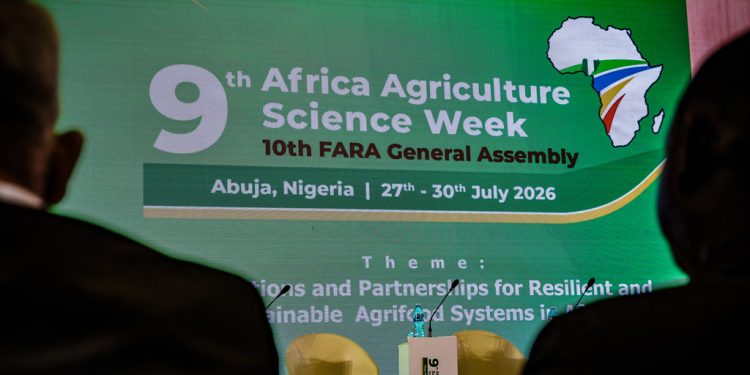
Presenting an executive brief prepared for ministerial-level consideration, Egeru said the evidence for agroecology’s performance in Africa is now “real and expanding,” but warned that adoption remains uneven and largely dependent on donor projects rather than embedded in national or landscape-level policy. He was speaking at the session “Agroecology and Ecological Organic Agriculture at Scale: Levers and Inhibitors for Sustainable Food Systems,” held under the broader theme “Food Sovereignty in Africa: Scaling Agroecology and Ecological Organic Agriculture for Resilient and Sustainable Agrifood Systems in Africa.” The session was moderated by Markus Arbenz of the Research Institute of Organic Agriculture (FiBL), Switzerland.

The panel on Agroecology and Ecological Organic Agriculture at Scale: Levers and Inhibitors for Sustainable Food Systems
“Farmer-level demand and civil-society delivery capacity for agroecology now outpace the public research, finance and formal-education systems meant to support and sustain it.”
A Continental Policy Window
Egeru grounded his remarks in the political momentum created by the Kampala CAADP Declaration, adopted by African Union Heads of State in January 2025, and its accompanying Strategy and Action Plan for 2026-2035, which for the first-time names agroecology as a core continental strategy for safeguarding biodiversity, improving nutrition, restoring soil health and strengthening local food systems. He described the declaration as the strongest continental policy signal on agroecology to date, and said it now falls to ministries to translate that commitment into budget lines, extension reform and territorial planning.
Evidence from the Field
Citing a systematic review of 70 peer-reviewed studies spanning 25 African countries between 2019 and 2024, Egeru said Senegal, Kenya, Tanzania and Burkina Faso are furthest along in scaling agroecological practice, supported by stronger institutions, policy and financing. He noted that farmer-level adoption in Benin, estimated at roughly 10 percent, is broadly representative of much of the region. Data from FAO’s Tool for Agroecology Performance Evaluation, applied across roughly 2,500 households in eight countries including Benin, Ethiopia, Kenya and Madagascar, consistently shows that greater agroecological integration improves economic, environmental and social outcomes without sacrificing productivity, he said.
He pointed to a series of independently verified on-farm results: Farmer-Managed Natural Regeneration, practiced across 24 million hectares from Niger to Ethiopia and Malawi, has lifted yields by an average of 50 percent and helped double household incomes through firewood sales, while regenerating some 200 million trees over two decades. Push-pull cereal-legume intercropping, now used by more than 155,000 smallholders in Kenya, Uganda, Tanzania and Ethiopia, has raised maize yields by up to 2.2 times and cut stemborer crop losses from around 40 percent to about 5 percent. In Burkina Faso, the combination of zaï pits and stone bunds has restored between 200,000 and 300,000 hectares of degraded land, in some cases lifting yields by as much as 500 percent and adding roughly 80,000 tonnes of food production annually. In deed over the last two years, the Innovation Transfer Partners (ITPs) model implemented by RUFORUM for scaling and deepening impact of technology and innovations transfer has demonstrated that young agro-preneurs can sustain the momentum of deliverying agroecology TIMPs to farmers at scale. This is because they have been able to reach over 200,000 farmers in under 24 months in Uganda, Kenya, and Tanzania. This is therefore an approach that is scalable with multiple wins of jobs and wealth creation, inclusion, and environmental sustainability among others.
Egeru also highlighted institutional shifts underpinning this progress, including Zimbabwe’s formal adoption of agroecology as a national climate adaptation strategy, CGIAR-led “Agroecological Living Landscapes” now operating in five countries, the integration of agroecology into university curricula in Kenya, and the institutionalization of Farmer Field School delivery within government extension systems in Ethiopia, Kenya, Uganda and Tanzania.
A Capacity Gap leaders and decision makers Must Close
Despite this progress, Egeru cautioned that human and institutional capacity remains the binding constraint. He cited data showing that only 13 percent of projects at Kenyan agricultural research institutes are linked to agroecology, that official development assistance for agricultural research, education and extension has stagnated at around 14 percent of agricultural aid to Sub-Saharan Africa, and that 85 percent of a major global foundation’s agricultural funding continues to flow toward industrial-production models rather than agroecological research.
On the delivery side, he described more encouraging signs: 661 Farmer Field School facilitators trained across East Africa, 32 percent of them women and 54 percent youth, backed by a growing corps of master trainers and a deliberate shift away from donor dependence toward government-owned extension systems. Youth agribusiness programmes such as ENABLE-TAAT have reached over 1,400 young agripreneurs in Kenya, Nigeria and Uganda, though he noted that access to capital and markets remains the chief obstacle for agroecological enterprises specifically. He added that civil-society and farmer networks, among them the PELUM Association, working with 283 organizations across 12 countries, and the Alliance for Food Sovereignty in Africa, whose 43 member networks reach an estimated 200 million people, now constitute the largest existing delivery infrastructure for agroecology, even though this capacity sits largely outside formal research, extension and education systems.
Farmer demand and civil-society reach now outstrip the public systems built to sustain them — a gap ministers are being asked to close.
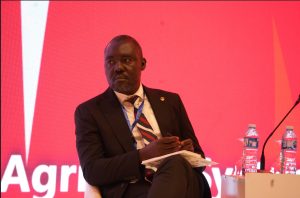
Professor Anthony Egeru
Three Priorities for leaders and decision maker’s Action
Egeru closed his presentation with three priorities he urged ministers attending FARA Science Week to act on at landscape level. First, redirect and de-risk finance toward agroecological research, extension and enterprise, through explicit budget lines and blended-finance instruments tied to Kampala Declaration commitments. Second, institutionalize farmer-centred, multi-stakeholder knowledge systems within public extension, funding national agroecology-extension cadres as core civil-service functions rather than project add-ons. Third, govern agroecological transitions at landscape and territorial scale, with secure land tenure and integrated value chains, coordinating research institutions, local government, the private sector and communities within defined territories.
He recommended that countries without national agroecology strategies adopt or finalize them using the Kenya and Senegal models as templates, ring-fence a minimum share of agricultural research and extension budgets for agroecology, formalize agroecology-trained extension cadres within the civil service, and designate priority landscapes for territorial transitions anchored in multi-stakeholder governance platforms.
Moderated Discussion
Moderating the session, Markus Arbenz of FiBL Switzerland invited participants to weigh the levers and inhibitors shaping agroecology’s path to scale across the continent, framing the discussion that followed Egeru’s remarks. The session forms part of the wider FARA Science Week conference which is currently underway in Abuja, Nigeria bringing together researchers, policymakers and civil-society actors to define the path for scaling agroecology and ecological organic agriculture across African agrifood systems.
In concluding the brief, it was noted that while the political and scientific case for agroecology in Africa is now well established, its long-term durability depends on whether ministries move deliberately to close the financing and human-capital gaps identified, a challenge Egeru framed as the defining task for the sector over the coming decade.