Beyond the classroom door: How TAGDev universities are turning out-of-school youth into agripreneurs

Across fifteen (15) universities, thousands of young people with no classroom seat are being apprenticed into cassava, dairy, vermiculture and rice-fish businesses – proof, consortium members say, that entrepreneurship training works best when it leaves the campus behind
Not every young entrepreneur being trained under the Transforming African Agricultural Universities to Meaningfully Contribute to Africa’s Growth and Development (TAGDev) consortium has ever set foot in a university lecture hall. Many are out-of-school youth in vermiculture yards, tomato nurseries, tree-planting fields and hospitality kitchens. Therefor the TAGDev programme has a deliberate target of a continent-wide push to seed and scale youth-led agribusiness far beyond the traditional campus gate.
Across fifteen universities in the consortium, a pattern is emerging: entrepreneurship support is being built not as a single course, but as a pipeline – needs assessments, co-created curricula, hands-on apprenticeships, and finally, links to markets, mentors and capital. The businesses taking shape at the end of that pipeline range from rice-fish integration in Nigeria to coffee planting in Uganda, poultry and mushroom enterprises in Zimbabwe, and fashion design in Kenya.
Counting the youth reached
The scale of direct youth engagement is striking. The University of Cape Coast in Ghana has trained 1,442 out-of-school youth and learners across tomato, vegetable, sweet potato, cassava and pineapple value chains, including women, people with disabilities and returnee migrants, on top of 655 youth trained separately in experiential agripreneurship. The University of Port Harcourt in Nigeria has trained 286 people – 212 of them women and 126 under the age of 35 – in enterprise creation spanning cassava, plantain, rice, poultry, palm-kernel and fish-farming businesses. Africa University’s partner institutions, Magamba Vocational Training Centre and Mutare Polytechnic, have between them trained 259 out-of-school youth in Zimbabwe across horticulture, poultry, fisheries, mushroom production, food processing, garment making and cosmetology.
At the National University of Agriculture in Benin, a curriculum built from a formal needs assessment is now training young entrepreneurs directly: 25 in ecological beekeeping, 32 in mushroom production and 68 in roots-and-tubers value chains. The demand signal behind this pipeline is telling – an apprenticeship call drew 1,220 applications, of which 1,112 were validated for selection after duplicates were removed, evidence of an appetite for opportunity that still outstrips available slots.
Learning by doing, not by lecture
What distinguishes this strand of TAGDev’s work is its insistence on apprenticeship over classroom instruction. At the University of Eldoret in Kenya, 150 out-of-school youth began hands-on apprenticeships in vermiculture and organic waste management at Mzuri Organics, while a separate cohort of 26 youth is training in vermicompost and frass production through the Ainabkoi Farmers’ Cooperative. In Uganda, Bugema University – an associate partner of Uganda Martyrs University, has trained 140 out-of-school youth in coffee planting and Napier seed supply, while Kabale University has identified a model village in Nakivale and is supporting nine (9) youth-led innovation projects.
The University of Bamenda in Cameroon has widened applied learning through a TAGDev greenhouse at the Hortifloral Institute in Buea, which hosted 20 students for practical exposure, alongside a training that reached 152 youth for employment and entrepreneurship mentoring. At the University of Free State in South Africa, 67 unemployed youth in Bloemfontein, Botshabelo and Thabanchu have gone through agripreneurship and pitching training, with ten (10) standout participants selected for continued support on compliance, marketing and access to funding.
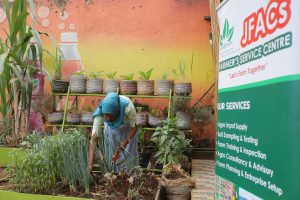
A TAGDev business beneficiary in Uganda – Juma Farm
Co-creating curricula with industry
Rather than designing courses in isolation, several TAGDev implementing universities are building agribusiness curricula jointly with TVET institutions and industry partners. Gulu University co-created two modular curricula – in market-oriented vegetable production and tree-nursery establishment – with representatives from six (6) TVETs, three (3) universities and industry actors. The University of Port Harcourt co-created modules on rice-value-chain enterprise, good agronomic practice and integrated rice-fish farming with technical partners, and is finalizing an apprenticeship scheme with Nigeria’s National Directorate of Employment. Malawi University of Science and Technology has already developed a competence-based curriculum on agripreneurship specifically for out-of-school youth, building on gap discussions with Sonda Technical College and a signed Memorandum of Understanding with Atsikana Walani Technical College.
Building the funding and partnership base
Behind the training numbers, TAGDev implementing universities are also laying institutional groundwork to sustain and scale these ventures. In Ethiopia, Haramaya University signed sub-grant agreements with Wollo and Mekelle universities and formed partnerships with two (2) TVET institutions, broadening its technical delivery base with RUFORUM, AGRA and TAGDev 2.0 support. Mohamed VI Polytechnic University in Morroco is developing a Digital Farming School entrepreneurship module with INP-HB, due to launch in September 2026, while continuing to align activities with its Community Based Learning Programme coordination team. In Senegal, Université du Sine Saloum El-Hâdj Ibrahima NIASS has finalized training-needs questionnaires as a first step toward co-developing curricula with Cheikh Anta Diop University, TVET institutions and an agricultural high school.
The long game
Much of this work remains in motion. For example, modules are still being piloted, apprenticeship placements still being finalized, funding partnerships still being signed. The direction, however, is consistent. Across the consortium, universities are betting that the surest way to seed youth agribusiness is not simply to teach entrepreneurship, but to place young people directly inside functioning value chains, apprentice them to working farmers and enterprises, and only then connect them to the grants, markets and mentors needed to scale what they build.