Re-writing the Rulebook: Inside the quiet policy revolution re-making 15 African Universities
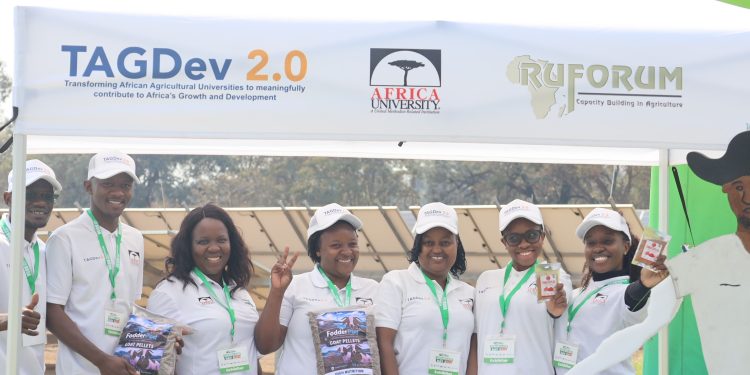
It rarely makes headlines when a university revises its policy-development template, or when a Board of Postgraduate Studies approves a new plagiarism-and-AI policy. Yet it is precisely this unglamorous work – policy by policy, curriculum by curriculum, workshop by workshop – that fifteen universities in the Transforming African Agricultural Universities to Meaningfully Contribute to Africa’s Growth and Development (TAGDev) 2.0 consortium say is quietly reshaping how African higher education institutions are governed and how they teach the next generation of agripreneurs.
Across Africa, from Zimbabwe to Senegal, Uganda to Ghana, universities in the consortium have spent recent months pushing through a wave of institutional reform: reviewing policies to align with the changing higher education landscape, converting degree programmes to competency-based models, and retraining hundreds of lecturers and administrators in inclusive, entrepreneurial teaching. Each step may look administrative but taken together, the consortium argues, they add up to systemic transformation.
A continent-wide policy sprint
Nowhere is the reform drive more visible than in the sheer volume of policy work underway. Egerton University in Kenya has adopted a standardized Policy Development Template to bring consistency to reviews, even as its Industrial Attachment Policy nears Council approval and policies on Teaching Practice, Entrepreneurship, Inclusivity, Careers and Safeguarding move through review. The University of Port Harcourt in Nigeria has nine draft policies – spanning community engagement, digital economy, mental health and intellectual property – sitting in a RUFORUM Sharepoint repository awaiting Senate approval. At Malawi University of Science and Technology, a gap analysis across 32 institutional policies exposed weaknesses in digital governance, research integrity and student protection, prompting new draft Digital Economy and Community Engagement policies.
Uganda Martyrs University has pushed a Digital Economy Policy to final internal review after quality-assurance feedback – and, notably, its review process concluded that the institution now needs a standalone artificial intelligence policy of its own, a sign of how quickly governance concerns are evolving alongside classroom technology. Gulu University, meanwhile, has already secured approval for a Gender Equity and Inclusion Policy, with a revised Disability and Special Needs Policy awaiting institutional sign-off.
The competency-based curriculum wave
Behind the policy paperwork lies a more fundamental shift: a continent-wide move toward competency-based education (CBE) and training (CBET). Sokoine University of Agriculture in Tanzania has secured national accreditation for three new competence-based undergraduate curricula, and of 111 curricula reviewed in line with CBE principles, 99 are already being implemented – reaching 6,242 first-year students, including 28 students with disabilities. The University of Eldoret has identified 23 academic programmes for CBE/CBET alignment in partnership with JOOUST (Jaramogi Oginga Odinga University of Science and Technology, Moi University and MMUST (Masinde Muliro University of Science and Technology), while shifting Agriculture, Animal Science and Horticulture practicums from university campuses to real farms.
Haramaya University in Ethiopia has reviewed more than 66 undergraduate and postgraduate programmes for entrepreneurship, digital pedagogy and social responsiveness, and the University of Cape Coast in Ghana has advanced 11 curricula, including a new BSc in Agri-food Systems and Technology, to accreditation review. In Uganda, Bugema University on the Uganda Martyrs university consortium has split its Diploma in Agricultural Production into two distinct, nationally approved programmes in crop and animal production, while Kabale University has drafted a new MSc in Sustainable Food Systems.
Retraining the trainers
None of this curriculum reform means much without lecturers equipped to deliver it, and the consortium has invested heavily in staff retooling. Gulu University trained 39 academic staff across three universities on competency-based curriculum design, naming participants as faculty-level transition champions. The University of Eldoret retooled 95 academic staff on CBE/CBET design and the recognition of prior learning. The University of Port Harcourt trained 114 teaching, administrative and technical staff – split evenly between men and women – in transformative education facilitation, disability awareness and gender-responsive pedagogy. Mohamed VI Polytechnic University in Morocco ran a two-day workshop on transformative and inclusive pedagogies for 23 participants drawn from 14 different institutions.
Inclusion woven through re-form
Gender and disability inclusion feature prominently across nearly every university’s reported work, rather than sitting apart as a separate track. Africa University trained 45 staff and stakeholders – spanning the university, four TVET institutions, the Tertiary Education Service Council and government ministry officials – on disability-responsive teaching. The University of Free State hosted a virtual workshop on inclusive terminology and gender-responsive pedagogy for 47 participants advertised across the RUFORUM network. The University of Bamenda has partnered with Doctors of the World to co-develop seven training modules on gender-based violence and safeguarding, alongside a course on climate change and sustainable development now reaching over 9,500 students.
An emerging common architecture
What distinguishes this phase of reform, consortium members suggest, is coordination. The National University of Agriculture harmonized data tools for assessing entrepreneurship and experiential learning across its schools. Université du Sine Saloum El-Hâdj Ibrahima NIASS is co-developing competency-based curricula jointly with Cheikh Anta Diop University and local TVET institutions. And Gulu University’s Program Advisory Committee has begun using an Institutional Capacity Action Plan to align governance, financial accountability and staff development priorities across the wider partnership – evidence that individual institutional reforms are increasingly being stitched into a shared system rather than pursued in isolation.
For a consortium built around transforming agricultural education, the lesson so far is that transformation is rarely dramatic. It looks instead like a template adopted here, a policy approved there, a workshop that quietly changes how 95 lecturers grade a practicum. Multiplied across fifteen universities, consortium leaders argue, that is exactly how systems change.