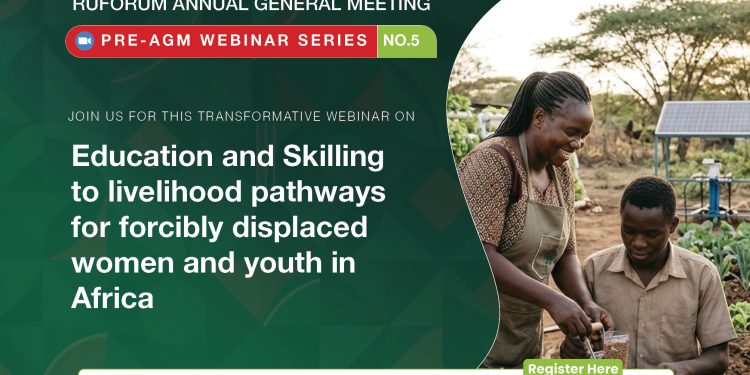
Pre-AGM webinar: Education and Skilling to livelihood pathways for forcibly displaced women and youth in Africa
CONCEPT NOTE
Date: 23rd November 2026 | Time: 11:00–13:30 East African Time | Virtual
Registration Link: https://bit.ly/4kFhBx9
Contacts: Keghah Roger Nuah: aorwuganda@gmail.com
Professor Anthony Egeru: a.egeru@ruforum.org
1. Background
Africa remains at the centre of the global displacement crisis, with an estimated 48 million refugees, asylum seekers and internally displaced persons (IDPs) (UNHCR, 2026). Sub-Saharan Africa hosted about 31.7 million IDPs at the end of 2025 and accounted for 14.5 million new conflict-related displacements during the year, nearly 45% of the global total (IDMC, 2026). Women and children make up the large majority of those displaced. Education, the first step towards self-reliance, is where the pathway breaks down. In 2025, only 32% of secondary-age refugee children were enrolled in school; girls’ transition to secondary school was described as near breaking point; and refugee tertiary enrolment, at 11%, remained below national averages in more than 80% of reporting countries (UNHCR, 2026). Funding cuts to UNHCR and other support organisations are widening these gaps. Displaced women face gender-based violence, early marriage, unpaid care work and discriminatory norms, while displaced youth face interrupted education, limited workplace exposure and few routes into enterprise. Many remain in low-income, informal and insecure work. The experience of TAGDev 2.0, implemented by RUFORUM with 12 member universities and TVET institutions in ten countries with support from the Mastercard Foundation, confirms that education and skills training alone do not secure livelihoods. The transition into enterprise, employment and economic integration requires integrated, gender-responsive and market-driven pathways.
2. Rationale
Many programmes treat the symptoms rather than the underlying causes of exclusion, and few manage the transition from learning to employment and enterprise. Because the barriers are interlinked and specific to each context, they are best diagnosed from the bottom up by refugee-led organisations, particularly those led by women and youth, which hold the necessary lived experience and local knowledge.
RUFORUM and the Association of Refugee Women in Uganda (AORW-U) are therefore convening RLOs, refugee support organisations (RSOs), governments, the private sector, universities and technical and vocational education and training (TVET) institutions to agree on priority challenges and solutions, clarify the leadership roles of RLOs, and shape recommendations for the 22nd RUFORUM Annual General Meeting (AGM) in Lusaka, Zambia, on 2 December 2026. The Lusaka meeting will develop country-specific interventions to reach 300,000 refugees and displaced persons (RDPs) and to support 64,000 of them into work by 2033.
3. Purpose and objectives
The purpose of the consultation is to build consensus among RLOs, RSOs and other stakeholders on the barriers that forcibly displaced women and youth face in moving from education and skills development to enterprise, livelihoods and economic integration; to explore the underlying causes; and to generate practical, refugee-led solutions. The specific objectives are to:
a) identify and prioritise the interconnected barriers and their root causes;
(b) document RLO-led practices and scalable solutions that work;
(c) define leadership roles for women- and youth-led RLOs and their partnerships with other actors
in addressing these challenges; and
(d) agree on the priority actions, responsibilities and partners for an RLO-led action agenda.
Approach and methodology
The two-and-a-half-hour consultation will be participatory, bottom-up and solution-oriented, with refugee women, youth and their organisations at its centre. It will comprise the following elements:
(a) Context setting. RUFORUM and AORW-U will introduce the objectives, the expected outputs and lessons from interventions such as TAGDev 2.0.
(b) Experience sharing led by RLOs. Women- and youth-led RLOs from different hosting contexts will share barriers, root causes and community-led solutions.
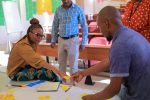
(c) Thematic breakout groups. Three facilitated groups, on education and market-responsive skills, on entrepreneurship and livelihoods, and on economic integration and RLO leadership, will identify challenges, causes, solutions and responsible actors. They will be guided by four
questions: What are the main barriers and their causes? How do they differ by gender, age and context? What has worked, and what more is needed? What role should each actor play?
(d) Plenary and consensus building. The groups will present their findings for validation and prioritisation, identifying cross-cutting issues and priority recommendations.
(e) Documentation and follow-up. RUFORUM and AORW-U will consolidate the results into an outcome report and action matrix to inform the AGM dialogue in Lusaka.
5. Expected deliverable and outcomes
The consultation will produce a report setting out the prioritised challenges, root causes, practical solutions, implementing partners and RLO leadership responsibilities. The report will form the basis of a Refugee Women and Youth Education, Skills and Sustainable Livelihoods Action Agenda, to be discussed in detail in Lusaka. The expected outcomes are:
(a) a validated, prioritised list of interconnected barriers;
(b) documented RLO-informed, gender-responsive solutions that could be adapted or scaled;
(c) agreed roles for women- and youth-led RLOs; and
(d) identified opportunities for partnership.
6. Conveners and participants
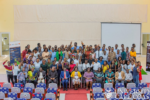
The consultation is jointly convened by RUFORUM, which leads coordination, facilitation and links with universities and TVET institutions, and AORW-U, which leads the mobilisation of women- and youthled RLOs and ensures that refugee voices shape the deliberations. UNHCR and the World University Service of Canada (WUSC) will provide technical support. About 80 to 100 participants are expected, with priority given to women- and youth-led RLOs. Proposed participants include:
(a) Refugee-led organisations: AORW-U, YARID, RELON Uganda and RELON Kenya, among others;
(b) Refugee support organisations: UNHCR, WUSC, JRS, Windle International and the International Rescue Committee, among others;
(c) Universities and TVET institutions: including RUFORUM member universities implementing TAGDev 2.0;
(d) Government: refugee affairs authorities, ministries and local governments;
(e) Private sector and financial institutions: employers, agribusinesses, incubators and financial service providers; and
(f) Development partners: including the Mastercard Foundation.
7. TENTATIVE PROGRAMME
| Time (EAT) | Activity | Facilitator |
| 15:00–15:05 | Welcome, introductions and overview of the consultation’s objectives and expected outputs | RUFORUM Secretariat |
| 15:05–15:15 | Opening address: The role of refugee-led organisations in advancing inclusive education, entrepreneurship and sustainable livelihoods | AORW-U |
| 15:15–15:55 | Experience-sharing panel led by RLOs: Perspectives from refugee women- and youth-led organisations on priority barriers, underlying causes and solutions that work (four speakers, ten minutes each) | AORW-U
RELON Uganda Cameroon |
| 15:55–16:10 | Reflections from refugee support organisations on strengthening education-to-livelihood transitions and RLO-led solutions | UNHCR
WUSC |
| 16:10–16:40 | Thematic breakout discussions: barriers, root causes, solutions and responsible actors
Group 1: Education and market-responsive skills Group 2: Entrepreneurship and sustainable livelihoods Group 3: Economic integration and RLO leadership |
Group chairpersons and Rapporteurs |
| 16:40–16:55 | Presentations from the breakout groups: key challenges, practical solutions and priority actions (five minutes per group) | Group rapporteurs |
| 16:55–17:25 | Plenary discussion, validation and consensus on priority recommendations, partnership opportunities and RLO leadership roles | Facilitator |
| 17:25–17:30 | Summary of agreed actions, next steps and closing remarks | Prof. Anthony Egeru, RUFORUM Secretariat |