Zambia Higher Education Day: Strengthening the Role, Relevance and Impact of Higher Education in Delivering the Grow Zambia Agenda
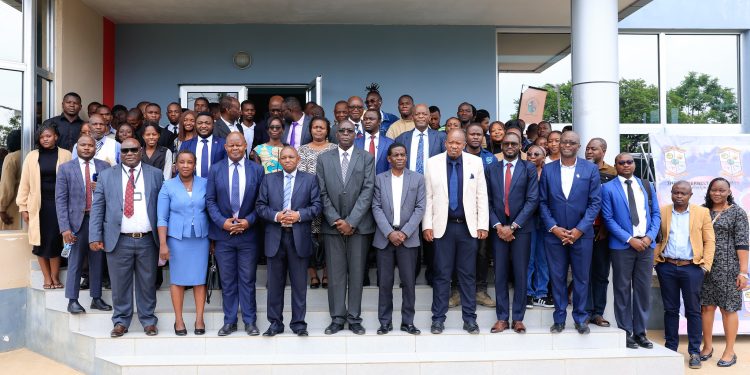
LUSAKA | 26 November 2026 — The herculean task of understanding what “transformation” actually demands of those expected to deliver it took centre stage at the inaugural Zambia Higher Education Day, held on Thursday at the University of Zambia’s Graduate School of Business. Government and education stakeholders explored what transformation demands of the higher education sector and how it can contribute more strategically to the national Grow Zambia Agenda.
Launched in September 2026, the Government’s Grow Zambia Agenda sets an ambitious objective of more than doubling the economy within five years. At its heart are eight major production targets spanning agriculture, energy, mining and tourism.
Zambia’s growth code is expressed in eight numbers: 10-10-5-3-3-1-1-1. Ten million tonnes of maize, 10,000 megawatts of power, five million tourists a year, three million tonnes each of copper and soya, a million tonnes each of wheat and sugar, and US$1 billion in beef exports.
But behind these numbers lies a less visible and less frequently discussed, yet equally important equation – the human and intellectual capacity required to make them achievable.

Panelists during a panel session on Harnessing science, technology and innovation to underpin the Grow Zambia Agenda
Almost 60 years after Dr Kenneth Kaunda’s vision for Zambia’s first university culminated in the establishment of the University of Zambia (UNZA) in 1965, the institution finds itself confronting a question that remains as relevant today as it was at its founding, what must universities and colleges do to give Zambia the people, ideas and evidence it needs to grow?
Welcoming delegates in four national languages during the University’s Diamond Jubilee year, Vice-Chancellor Professor Mundia Muya challenged the higher education sector to consider its place in the country’s next chapter of development.
His proposition was to read the growth code the way a university would. “Every number is a research question and a training need,” he said. The Grow Zambia Agenda, in his words, “is, at its heart, a knowledge agenda”. This perspective shifts the conversation from what Zambia wants to produce to what it must know, develop and invest in to produce it.
This connection between economic ambition and institutional capacity was explored in the keynote presentation, From Ambition to Delivery: Foresight, Economic and Policy Evidence for the Grow Zambia Agenda and the National Development Plan, delivered by Dr Brian P. Mulenga of the Indaba Agricultural Policy Research Institute (IAPRI).
The presentation challenged stakeholders to look beyond the headline production targets and interrogate the capabilities, systems and investments needed to achieve them. It highlighted the importance of productivity, research and innovation, climate resilience, market absorption and the linkages connecting different sectors of the economy.
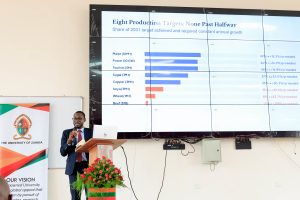
Dr Brian P. Mulenga of the Indaba Agricultural Policy Research Institute (IAPRI), giving his presentation on the lead paper for Zambia’s Higher Education Day
This year, Parliament made free education from early childhood to secondary school a legal right. Dr. Kelvin Mambwe, Permanent Secretary for Education Services, whose speech was read by a ministry representative, warned that universities and colleges must prepare for a growing number of young people who will soon be knocking on their doors.
The creation of the Ministry of Skills and Higher Education was interpreted during the discussions as a signal of the growing importance of skills development in the country’s development agenda.
For RUFORUM Executive Secretary Professor Patrick Okori, this distinction is important. He noted that education remains fundamental, but the development imperative increasingly requires a stronger focus on skilling.
He challenged universities to rethink how they demonstrate their contribution to national development, cautioning that institutions should be prepared to account for the relevance of their skilling programmes, particularly as public resources come under pressure.
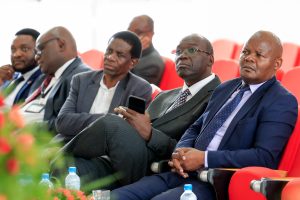
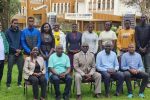
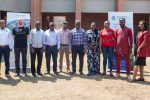
Vice Chancellors, RUFORUM and Ministry officials in attendance
The implication is not that academic knowledge and research have become less important. Rather, the challenge is to connect knowledge more deliberately to application, productivity, enterprise creation and problem-solving.
Skilling without scientific research risks preparing a workforce to operate technologies that the country has limited capacity to develop, adapt or improve. Conversely, research without pathways to application risks leaving valuable discoveries confined to academic publications rather than translating into solutions for farmers, industries and communities.
The real challenge is therefore not choosing between skills and science, but building a system in which the two reinforce one another.
A recurring message throughout the Day was that higher education institutions must become more deliberate in aligning their work with the country’s development priorities.
Dr Mambwe outlined four key expectations: anticipating the workforce requirements of national production targets and aligning enrolment accordingly; strengthening connections between universities, colleges and technical and vocational education and training institutions; directing research towards the practical constraints affecting development; and measuring institutional performance not only through academic publications but also through graduate employment, technology adoption and enterprise creation.
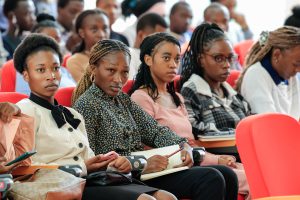
Students in attendance
UNZA committed to aligning its postgraduate research with the Grow Zambia priority value chains and opening its laboratories and farms to partners, seed companies and farmers.
Professor Muya further proposed a country compact involving Zambia’s four RUFORUM member universities – UNZA, the Copperbelt University, Mulungushi University and Kapasa Makasa University, with each taking leadership in areas aligned with its institutional strengths, while creating opportunities for other public and private institutions to participate.
Meanwhile, the Ministry of Skills and Higher Education indicated that it would take the proposals emerging from the Day to relevant line ministries and agencies for consideration in the formulation of the Ninth National Development Plan.
These commitments offer an opportunity to move beyond institutional collaboration as an aspiration towards a more coordinated national approach to research, skills development and innovation.

Professor Mwala leading a panel session on Unlocking inclusive opportunity for jobs, wealth creation and prosperity in Zambia
Professor Muya challenged every participant to leave with one commitment their institution would deliver within 12 months and one partner with whom to deliver it. It was a deliberate call to translate dialogue into measurable action.
Ultimately, the significance of Zambia Higher Education Day may lie less in any single recommendation than in the growing recognition that the future of higher education and the future of the Zambian economy are inseparable.
As Professor Patrick Okori reminded participants through his vision for Africa’s future, the continent’s young people will inherit the outcomes of decisions being made today. Preparing them must therefore begin now.
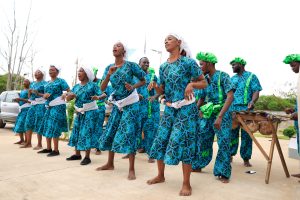
Zambia’s Higher Education Day came alive with a vibrant welcome from traditional dancers, reminding us that as we embrace innovation and new knowledge, our cultural heritage remains at the heart of who we are
Zambia Higher Education Day was co-organised by RUFORUM member universities in Zambia — the University of Zambia, Copperbelt University, Kapasa Makasa University and Mulungushi University, ahead of RUFORUM’s 22nd Annual General Meeting, scheduled for 30 November to 3 December 2026 at the Mulungushi International Conference Centre in Lusaka.