Two Sisters, One Opportunity: How Transformative Education Is Building Parallel Futures From a Single Investment
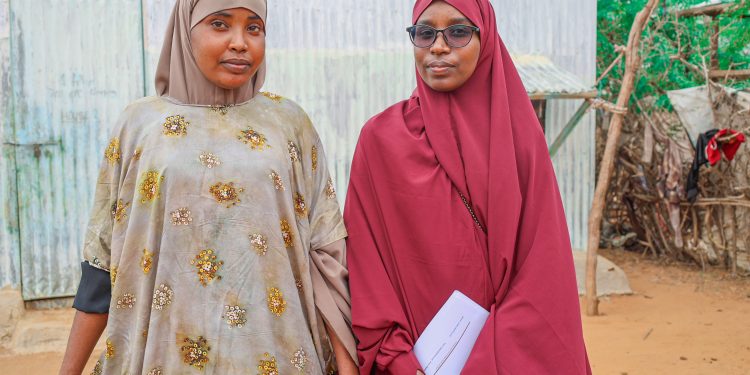
By Egerton University TAGDev Communication Team
For many children growing up in refugee camps, their world view is experienced through constant survival and uncertainty rather than possibility. For Nimo Khalif Abdi, access to education redefined her lived experience.
A Childhood Shaped by Displacement, Not Defined by It
In 2011, conflict forced Nimo’s family to flee Somalia for Kenya while she was still a young girl. Like thousands of other refugee families, survival depended largely on humanitarian assistance – food, shelter, and schooling all made possible through organizations including UNHCR, which supported her throughout primary and secondary education.
Life in the camp offered little room for ease: limited opportunity, economic hardship, and an uncertain future were constants. Yet Nimo refused to let those conditions set the limits of her ambition. She stayed focused on her education, convinced it was her clearest path forward and her results proved the conviction was well placed. She scored a B (Plain) on her KCSE exams, a grade that qualified her for university admission.
Qualified, Yet Still Locked Out
Grades alone weren’t enough. Nimo’s parents had no source of income, and university tuition remained entirely out of reach. She spent months applying to scholarship programmes, absorbing rejection after rejection, watching an earned opportunity sit just beyond her family’s financial means.
This is the exact pattern development partners should recognize as the clearest case for targeted investment: a student who had already met every academic requirement, blocked from higher education by resources alone.
The Opportunity That Changed the Equation
Hope was fading until a friend told her about the Transforming African Agricultural Universities to Meaningfully Contribute to Africa’s Growth and Development (TAGDev 2.0) scholarship programme, , implemented by Egerton University in Kenya with support from the Regional Universities Forum for Capacity Building in Agriculture (RUFORUM) and the Mastercard Foundation. Nimo applied with cautious optimism. When the acceptance email finally arrived, it confirmed what she had worked years to earn.
“The moment I received the email, I was overwhelmed with joy,” she recalls. “For the first time, I felt that my dreams were finally becoming possible. I knew there was hope not only for me but also for my family.”
The scholarship took Nimo from the refugee camp to Nakuru County to pursue a Bachelor of Science in Agriculture at Egerton University in kenya – her first experience living away from home and among people from different cultural and social backgrounds. With support from the TAGDev Programme, university staff, and new friends, she adjusted quickly and is now thriving both academically and personally, building practical skills in agriculture, agrifood systems, entrepreneurship, leadership, and community engagement — the exact toolkit needed to address food security challenges in communities like the one she came from.
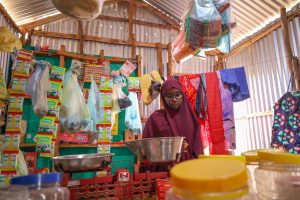
Nimo Khalif Abdi in her shop
One Stipend, Two Livelihoods
The most striking evidence of the scholarship’s reach lies outside the classroom entirely. Through careful saving of her student stipend, Nimo established a small retail and tailoring business for her sister back in the refugee camp — a sister who previously had no employment or reliable income of her own.
“Before my sister supported me, I stayed at home without any work,” Nimo’s sister explains. “Today I have my own shop where I sell retail goods and offer tailoring services. I can earn an income, support myself, and contribute to our family’s daily needs. This business has completely changed my life.”
What started as disciplined saving has become a sustainable source of income for the family — clear evidence that investing in one young person’s education can ripple outward to transform an entire household’s economic footing.
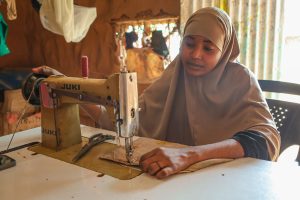
Nimo’s sister in her tailoring business
From Scholar to Advocate
Now in her second year, Nimo sees her journey as only beginning, confident that by graduation she’ll have the knowledge, experience, and confidence to create lasting change in her community and beyond. She is especially attentive to the barriers facing refugees and young women in accessing higher education, and has become an active advocate for the TAGDev Scholarship Program — sharing information with other young people in the camp and encouraging them to pursue higher education despite their circumstances. Her advocacy has contributed to a measurable increase in applications from the Dadaab Refugee Complex in recent recruitment cycles.
Why This Matters for Development Partners
Nimo’s story demonstrates precisely why refugee status should never be treated as a ceiling on opportunity. Every obstacle in her path — lack of family income, months of scholarship rejections — was circumstantial, not a reflection of ability or drive she had already proven twice over, first in her exam results and then in her tenacity applying for support. Once that circumstantial barrier was removed, the return multiplied almost immediately: a university degree in progress, a sister’s independent business, and a growing wave of new applicants inspired by her example.
“Were it not for this scholarship, my life would be completely different,” Nimo says. “This opportunity has given me hope, education, and the ability to support my family. It has secured my future.”
That is the case Nimo’s journey makes plainly: investing in refugee youth doesn’t change one life. It builds stronger families, more resilient communities, and a more inclusive future — proof that when refugees are given the same starting point as anyone else, they don’t just catch up. They begin expanding the horizon of what’s possible for everyone around them.