How a Young UCC Graduate Is Making Climate-Smart Agriculture More Affordable Through Shade Net Technology
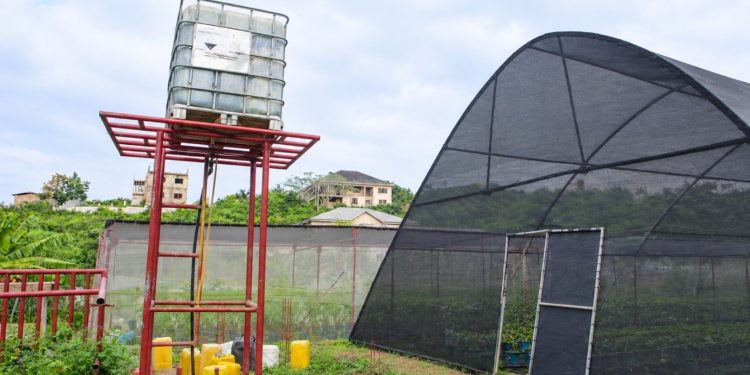
By Festus Annor-Frempong – TAGDev 2.0 Programme Coordinator
Louis Mensah, TAGDev 2.0 Communication Team Member
For Samuel Nana Yaw Darko, agriculture is more than an occupation; it is an avenue for innovation, entrepreneurship and job creation. A young agribusiness graduate of the University of Cape Coast (UCC), he believes agriculture holds enormous potential to transform livelihoods, particularly among young people, when they are equipped with the right skills and technologies.
His passion is driving his involvement in shade net construction, an affordable alternative to conventional greenhouse technology that is making protected vegetable cultivation more accessible to farmers and aspiring agripreneurs.
“I have always been passionate about agriculture because I see it as an area with enormous potential to transform lives and contribute to national development. It is not just about planting and harvesting crops; it is about innovation, solving problems and creating opportunities. I want to be part of the generation that changes how young people perceive and engage in agriculture,” he said.
Samuel’s journey into climate-smart agriculture began when he was recruited as an out-of-school youth under the Transforming African Agricultural Universities to Meaningfully Contribute to Africa’s Growth and Development (TAGDev) 2.0 programme to participate in training on climate-adaptive practices in vegetable cultivation.
The training, facilitated by Interplast, a plumbing and irrigation solutions company, equipped him with practical skills in irrigation system installation and shade net construction. It also introduced him to affordable technologies capable of addressing some of the challenges confronting vegetable farmers.
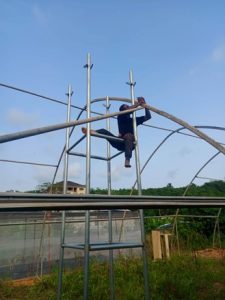
Construction of shade a net at Kasoa
While conventional greenhouse structures can cost between GH¢50,000 and GH¢100,000, shade net facilities can be constructed for between GH¢2,000 and GH¢10,000, depending on their size and irrigation requirements. This makes the technology a more affordable option for smallholder farmers and young people interested in commercial vegetable production.
From Trainee to Entrepreneur
Determined to translate his training into a viable enterprise, Samuel continued developing his technical expertise through practical experience. He has since become a shade net construction consultant under the TAGDev 2.0 programme at UCC.
Through this engagement, he has secured contracts to construct eight shade net facilities across selected communities and centres in the Central Region, including Bessakrom, Kwaprow, Kasoa, Ekumfi and the UCC Technology Village.
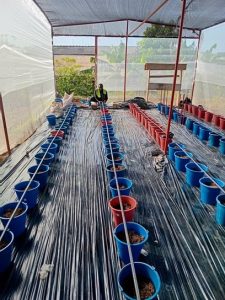
Beyond providing infrastructure for vegetable production, the facilities serve as practical training grounds where out-of-school youth acquire skills in climate-smart agriculture and explore opportunities for self-employment.
Cucumber and tomato are currently being cultivated under the shade nets, providing beneficiaries with hands-on experience in vegetable production, irrigation management and protected cultivation.
For Samuel, the opportunity is particularly meaningful because of its potential to empower young people.
“One of my greatest motivations is to see young people develop themselves and become independent through agriculture. I want the skills and knowledge I have acquired to benefit others, particularly out-of-school youth who may not have many opportunities. If I can help equip them with practical skills that enable them to earn a living and build their future, then I believe I am making a meaningful contribution,” he said.
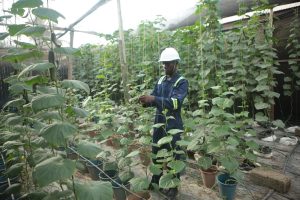
Samuel tending to the crops inside the shade net
He considers agriculture one of the most promising sectors for addressing youth unemployment, stressing that young people must begin to recognise it as a business with opportunities across the agricultural value chain.
“I strongly believe agriculture is one of the greatest sources of employment creation, especially for the youth. There are so many opportunities along the agricultural value chain, but we need to change our mindset and begin to see agriculture as a viable business rather than just subsistence farming. With the right skills, technology and support, young people can create jobs for themselves and employ others,” he emphasised.
An Affordable Response to Water Challenges
Shade net technology also presents opportunities for more efficient water management, particularly in areas where unreliable water supply affects vegetable production.
In parts of the Central Region, including Cape Coast, water availability remains a challenge for farmers. Shade nets help moderate growing conditions by reducing direct sunlight and excessive moisture loss from the soil. When combined with properly installed irrigation systems, they can improve water-use efficiency and support more controlled vegetable production.
“Water availability is one of the challenges we have to consider when cultivating vegetables, especially in Cape Coast. With shade nets and properly installed irrigation systems, farmers can manage available water more efficiently. This makes vegetable cultivation more practical, even in areas where water supply is not always reliable,” he noted.
Developing the Next Generation of Agripreneurs
Samuel’s ambition extends beyond constructing shade nets. He envisions using the technology to develop a new generation of agricultural entrepreneurs equipped with practical and marketable skills.
Through training in shade net construction, irrigation system installation and precision agriculture, he hopes young people will establish businesses and provide services to farmers and other agricultural enterprises.
“My vision is not just to construct shade nets for people to grow vegetables. I want to use these facilities to develop young entrepreneurs who can establish their own agricultural businesses. Through training in shade net construction, irrigation systems and eventually precision agriculture, young people can acquire marketable skills and build enterprises around them. I want them to move beyond being trainees to becoming employers and innovators in the agricultural sector,” he explained.
His interest in precision agriculture stems from its potential to improve farming decisions through technology, data and scientific information, particularly in the management of water, land and other agricultural resources.
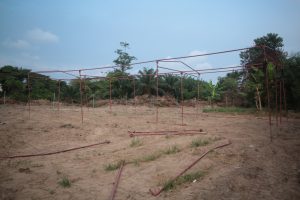
A new shade net under construction at the University of Cape Coast Technology Village
“I see precision agriculture as the next frontier for farming. Technology can help us use water, land and other resources more efficiently while improving productivity. I want to develop my expertise in this area so that I can introduce more innovative approaches to farming and help young people appreciate the business opportunities that modern agriculture offers,” he said.
He is looking forward to further training to deepen his knowledge and practical expertise in the area.
Beyond shade net construction, Samuel is also helping to develop two sweet potato fields under the climate-adaptive seed system, contributing to efforts to promote resilient crop varieties and sustainable agricultural production.
A Young Entrepreneur Changing the Narrative
Samuel’s journey demonstrates how practical, industry-led training can equip young people to identify and pursue emerging opportunities in agriculture.
From participating in a skills development programme to securing contracts for eight shade net facilities, he is translating acquired knowledge into an entrepreneurial venture while contributing to community development.
His experience reflects the objectives of TAGDev 2.0, which seeks to equip young people with relevant agricultural and entrepreneurial skills, expand livelihood opportunities and promote inclusive, climate-resilient food systems.
As he works towards expanding his shade net construction activities and incorporating precision agriculture into his operations, Samuel hopes to make modern farming more accessible and attractive to young people.
For him, the future of agriculture is not simply about growing crops; it is about growing businesses, developing people and building resilient communities.