Seeds of Inclusion: A Ugandan Youth Enterprise Proving Refugees and Host Farmers Can Grow Together
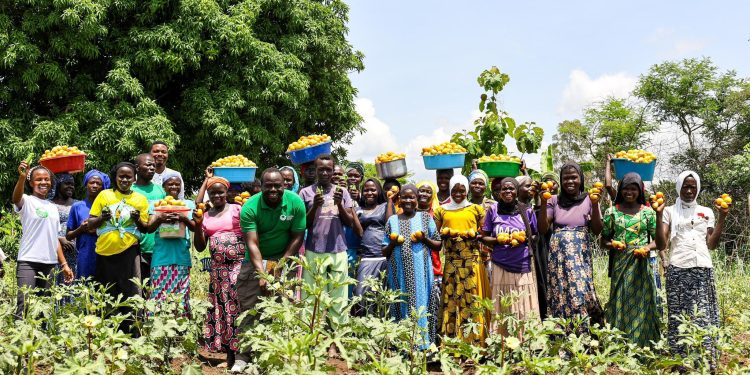
In West Nile, Rhino Camp, Kiryandongo, and Koboko, Uganda, a young agribusiness is subtly experimenting with an idea that development planners often struggle to operationalise: that refugees and the communities hosting them can be served by the same market, the same training, and the same supply chain, without one group crowding out the other.
The company is Omia Agribusiness Development Group Ltd, founded by Kato Omia Adilu. In a progress report covering January to June 2026, submitted to its partner the Regional Universities Forum for Capacity Building in Agriculture (RUFORUM), the young enterprise laid out numbers that read less like a corporate update and more like a working blueprint for inclusive rural development.
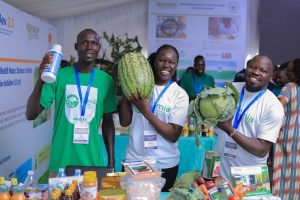
The team from Omia exhibiting at the Mastercard Foundation Executive Committee visit to the RUFORUM Secretariat in 2025
One Company, Three Services, Two Communities
Omia’s model is built on a simple bundle: farmers get access to quality agricultural inputs, free extension and technical training, and a guaranteed buyer for what they grow – all delivered through USSD codes, a toll-free line and a mobile app that put agronomic advice within reach of even the most remote smallholder. In just six months, that bundle reached 25,122 people, of whom 731 were refugees and 24,418 were members of host communities – farmers, in other words, sharing the same input dealer, the same extension officer, and the same buyer, regardless of their legal status.
The disaggregated numbers tell their own story of intent. Of 9,144 farmers who purchased climate-smart inputs, 352 were refugees; of 10,312 trained in climate-smart practices – through field visits, demonstration gardens, radio talk shows and that toll-free line – 296 were refugees and, notably, 8,003 were women. When Omia’s marketing arm, Omia Foods, bought back farmers’ harvests directly, 2 of the 357 suppliers were refugees; when it resold that produce – tomatoes, cabbage, onions, watermelon, eggs, chicken, sesame, beans, soybean and maize – to 5,309 hotels, market vendors, retailers and walk-in customers in Arua, refugee-run enterprises were represented among the sellers feeding that market too.
Women made up the clear majority of those reached – 12,684 of the 25,122 total, a signal that an agribusiness model built around accessible technology and low-cost group training can reach populations development programmes often find hardest to serve.
Obstacles Met with Local Fixes
The report does not gloss over the difficulty of the work. Extension services, offered free to farmers, proved expensive to deliver one household at a time – so Omia shifted to group-based training, cutting costs while building peer networks among farmers. Some smallholders could not afford even discounted inputs, prompting the company to design smaller, cheaper input packages and to support local agents to raise and sell seedlings directly in their communities. Persons with disabilities faced physical and communication barriers at some training sites; Omia responded by relocating demonstration gardens and trainings to more accessible locations. None of these were abstract policy fixes, they were adjustments made by a small company learning, in real time, what inclusion actually requires in practice.
Why Youth-Led Models Matter
What makes Omia’s case instructive is not the scale – 25,000 people is modest against West Nile’s broader displaced and host population, but the model itself. A youth-led enterprise, close to the communities it serves and unencumbered by the bureaucracy of larger humanitarian programming, was able to design a single market system that simultaneously treats refugees as customers and suppliers rather than as a separate caseload requiring parallel infrastructure. That is precisely the kind of durable, non-siloed integration that policymakers and funders have struggled to achieve through top-down programming alone.
For development practitioners and financiers looking to translate policy commitments on refugee inclusion into functioning markets, Omia Agribusiness offers a working example rather than a proposal: young entrepreneurs, backed by the right partnerships and digital tools, can build businesses that make host and refugee farmers economically interdependent, turning a policy aspiration into a functioning supply chain.