Contextualizing Transformative Education to Shape Africa’s Next Generation of Innovators
By Maureen Agena
The African Union’s Agenda 2063 articulates a clear continental ambition, to unlock Africa’s potential to feed itself and to harness the transformative power of its greatest asset, its people. While natural resources remain abundant and diverse, Africa’s long-term prosperity hinges on the strategic cultivation of human capital through robust, forward-looking education systems.
Like many governments across the continent, the Government of Botswana, the host of the Regional Universities Forum for Capacity Building in Agriculture (RUFORUM)’s 21st Annual General Meeting (AGM) aligns closely with the Sustainable Development Goals of zero hunger and no poverty. It also upholds the collective aspirations of African Heads of State and Government expressed in the Kampala Declaration under the Comprehensive African Agricultural Development Programme (CAADP).
Against this backdrop, the pre-AGM session on transformative education and ecosystem engagement convened hundreds of scholars, policymakers, and thought leaders from Africa and beyond. The discussions underscored a shared urgency that strategic collaboration must move from concept to action if the continent is to confront its pressing challenges of food insecurity, public health vulnerabilities, conflict and displacement, youth unemployment, and the persistent pressures of migration. The message was clear; Africa’s transformation requires not isolated interventions, but integrated, interdisciplinary solutions.
In fulfilling the CAADP agenda, universities stand at the forefront. They must leverage every available opportunity to generate workable, evidence-based solutions through science, technology, and innovation. However, they cannot act alone. National Agricultural Research Systems, the private sector, civil society, and development partners must each play an indispensable role in strengthening Africa’s education and agricultural systems. Together, these institutions form the ecosystem that will determine whether Africa can translate its ambitions into tangible progress.
universities exhibiting at the official opening of the AGM
The Youth Dividend
Since its establishment at Makerere University in Uganda, RUFORUM has supported the training of more than 3000 students across the continent at PhD, Masters, undergraduate and TVET level. These scholars, drawn from diverse African countries and hosted in universities across the region, represent a deliberate investment in building Africa’s scientific capacity and advancing pan-African collaboration. Notably, 98% of RUFORUM-supported graduates continue to work within their home countries or regions, reinforcing national and regional development efforts.
A key contributor to this impact is the Mastercard Foundation supported initiative, Transforming African Agricultural Universities to Meaningfully Contribute to Africa’s Growth and Development (TAGDev 2.0). This programme strengthens universities, Technical, and Vocational Education and Training (TVET) institutions to drive inclusive, equitable, and climate-resilient transformation of agriculture and agri-food systems. Through experiential learning, practical skills development, and youth empowerment, TAGDev enhances the ability of young Africans to engage meaningfully in agriculture as innovators, leaders, and entrepreneurs.
Across both TAGDev 1.0 and 2.0, thousands of young women and men have been equipped to establish profitable enterprises and create employment opportunities within their communities.
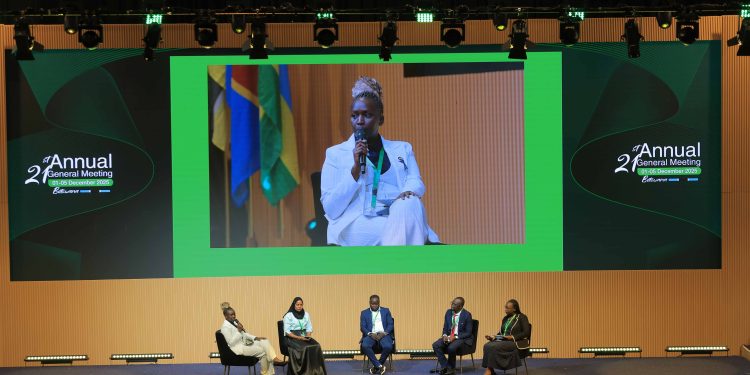
This transformative impact was evident during a keynote address by Dr. Dr. Yeukai Mlambo from the Mastercard Foundation followed by a panel session where four young entrepreneurs and beneficiaries of RUFORUM MasterCard supported programmes, shared their journeys. Their enterprises span a wide spectrum;- from improving and multiplying high-quality potato seed in Nakuru Kenya by Winnie Wambugu, to equipping differently abled persons (PWDs) with agronomy and entrepreneurship skills in Uganda by Zena Saliru, to skilling refugees in the west Nile region of Uganda by Gordon Victor Akejo to supporting out-of-school youth to become self-reliant by Kato Omia. These stories illustrate not only the ingenuity of Africa’s youth but also the importance of sustained investment in higher education and innovation ecosystems. They embody the youth dividend that Africa stands to gain if it continues to nurture the potential of its young people.
A moment Africa cannot afford to miss
As the conversations by the young entrepreneurs have made clear, Africa stands at a pivotal moment. The continent’s aspirations captured in Agenda 2063, the SDGs, and the CAADP commitments cannot be realised through intention alone. They demand systems that elevate human capital, institutions that collaborate rather than compete, and education models that prepare young people not merely to seek opportunity but to create it.
The stories shared by emerging entrepreneurs and young scientists are more than inspiring anecdotes; they are proof points. They show that when universities are empowered, when partnerships are genuine, and when young people are trusted with the tools and mentorship they need, transformation is already underway.
The scale of Africa’s challenges requires an equal scale in commitment by Governments, universities, research organisations, the private sector, and development partners who must deepen investments in higher education, innovation ecosystems, and youth-focused initiatives. Failure to do so risks squandering one of the continent’s most powerful assets, its demographic dividend.
Africa must therefore double down on transformative education and ecosystem-led collaboration. The momentum witnessed in Botswana should not end with the AGM. It should mark the beginning of renewed resolve to equip Africa’s young people with the skills, networks, and support they need to lead the continent’s next chapter.
The future is already taking shape in laboratories, fields, innovation hubs, and classrooms across the continent. It is time to scale what works and ensure that Africa’s brightest minds are empowered to build the strong and prosperous nations they envision. Collectively, we shall all achieve the Africa that we want.