“Be the Muni of the world, not the Oxford of Africa”: RUFORUM keynote urges young universities to build research cultures rooted in their own place
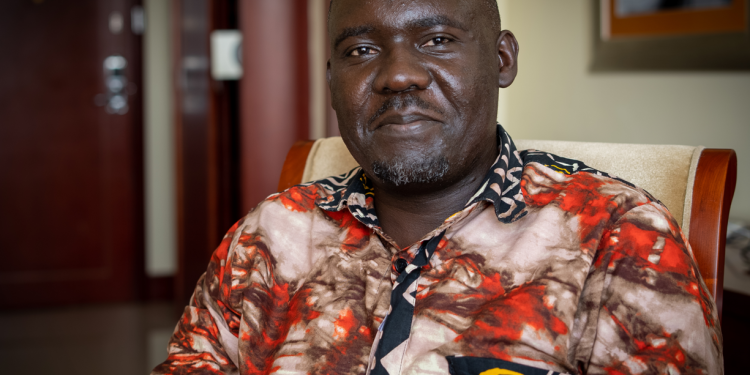
Arua, Uganda, 14 October 2026 – Africa is home to about 18% of the world’s people but accounts for roughly 1% of global spending on research and development. Delivering the keynote address at Muni University’s international conference on behalf of the Regional Universities Forum for Capacity Building in Agriculture (RUFORUM), Prof. Anthony Egeru told delegates that this gap explains much of the continent’s productivity problem, and that young universities are better placed than old ones to close it.
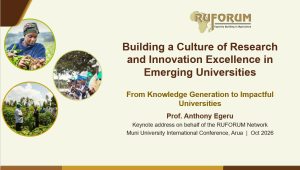
His address, “Building a Culture of Research and Innovation Excellence in Emerging Universities: From Knowledge Generation to Impactful Universities,” drew on global data on research investment, the economics of agricultural research, and two modelled scenarios for Muni University, which was established in 2013 and admitted its first students in 2014.
Research is an investment, not a cost
Prof. Egeru presented evidence that Uganda’s last reported research spending was 0.14% of GDP in 2014, compared with an African Union target of 1% and figures of 4.8% in South Korea and about 6% in Israel. Sub-Saharan Africa had about 124 researchers per million people in 2018. Yet the returns are high: a major meta-analysis of agricultural research found a median annual return of about 41% in developing countries.
He linked this directly to Uganda’s tenfold growth strategy, which aims to grow the economy from about US$50 billion to US$500 billion by 2040 through agro-industrialisation, tourism, minerals, and science, technology and innovation. That target requires growth of roughly 15.5% a year. “Growth at that speed cannot come from more land and more labour alone,” he said. “It comes from productivity, and productivity comes from research that reaches farms, firms and public services.”
From first- to fourth-generation universities
The keynote traced four generations of universities: the teaching university, the research university of the Humboldt tradition, the innovation university that commercialises knowledge, and the fourth-generation university that co-creates solutions with government, industry, civil society and communities, and judges itself by societal impact. Most African public universities, he argued, sit between the first and second generations, but they need not climb every step slowly. They can build fourth-generation habits into their research foundations now.
To guide that shift, Prof. Egeru introduced a “Roots-to-Fruits” model. Roots are the enablers leaders control: governance, talent, funding and infrastructure. The trunk is culture: rewards for impact, mentoring, integrity and protected research time. Branches are flagship research programmes and postgraduate training. Fruits are technologies adopted, enterprises, policies and livelihoods. Seeds are the income, data and reputation reinvested in the next cycle. He proposed a five-level scorecard, from inputs through culture, outputs and outcomes to impact, and urged universities to shift their reporting toward the last two levels.
| THE KEYNOTE IN NUMBERS | |
| About 1% | Africa’s share of global R&D spending, against 18% of world population (UNESCO, 2021) |
| 0.14% | Uganda’s last reported R&D spending as a share of GDP (2014); the AU target is 1% |
| 41% | Median annual return on agricultural research in developing countries (Rao, Hurley & Pardey) |
| ~15.5% | Annual growth Uganda needs to move from about US$50 bn to US$500 bn by 2040 |
| 13% vs 0.6% | Africa’s share of world honey production versus its share of honey export value (2024) |
| 2.0 million | Refugees in Uganda in April 2026, the largest refugee population in Africa |
Scenario one: West Nile honey on the world’s shelves
Africa produces about 13% of the world’s honey but earns only about 0.6% of global honey export value, roughly US$14 million in 2024. New Zealand alone earned about NZ$426 million from honey exports in 2025 by selling quality, science and a strong origin story. Prof. Egeru also highlighted conflicting estimates of Uganda’s own honey output, about 21,600 tonnes in international data against 210,000 tonnes in a 2026 national report, and called closing that data gap “a research question in its own right.”
Under a modelled scenario, West Nile honey worth an estimated US$6 million a year today could reach about US$76 million by 2040 if Muni University leads on productivity, quality testing, traceability, a West Nile origin brand and buyer contracts, compared with about US$10 million under business as usual. He proposed six interventions: a West Nile Honey Observatory, research on bee health and shea-flora forage, an accredited quality laboratory, digital hive-to-jar traceability, an origin brand or geographical indication, and incubation of youth enterprises in honey, wax and propolis.
Scenario two: from running RETI to leading refugee research
Uganda passed two million registered refugees in April 2026, the largest refugee population in Africa, while humanitarian funding has fallen sharply. Muni University leads the Refugee and Host Community Youth Empowerment and Transformation Initiative (RETI), supported by the Mastercard Foundation, which targets 100,000 young people, 70% of them refugees and 60% female, across refugee-hosting districts and cities with nine partners.
Prof. Egeru argued that RETI is already a world-scale experiment and should become a research asset: an open longitudinal panel of refugee and host youth, rigorous evidence on what works and at what cost, and a permanent institute linked to Muni’s planned Bidibidi campus. His 2040 roadmap moves through four phases, evidence, institute, regional hub and global norm-shaper, so that Muni becomes “the university UN agencies call first on refugee self-reliance in Africa.” Modelled refugee numbers in Uganda range from about 1.2 million to 3.7 million by 2040, and in every scenario, he noted, the demand for evidence on self-reliance rises as aid budgets shrink.
Messages for leaders and policy makers
The keynote closed with simple messages:
- Be Muni, not a copy of Oxford. A university’s place is its comparative advantage.
- Choose few and go deep. Three to five flagships where the university can lead globally.
- Reward what you want. Promotion and funding should count impact, not only papers.
- Measure what matters. Report outcomes and impact, and own your region’s data.
- Turn projects into institutions. Every major project should leave lasting research capacity behind.
For government, he called for research spending to rise toward the AU target of 1% of GDP, for public universities to be funded partly on impact, and for universities to sit inside the delivery teams of the tenfold strategy. He also urged development partners and UN agencies to fund African research institutions directly.
“Do not try to be the Oxford of Africa,” Prof. Egeru concluded. “Be the Muni of the world: the place everyone comes to learn how honey, youth and displaced people can build prosperity.”
About RUFORUM: The Regional Universities Forum for Capacity Building in Agriculture is a network of 175 universities in 40 African countries, working to strengthen the capacity of universities to foster innovations responsive to the demands of smallholder farmers and the agricultural sector.
Note: the honey, refugee and Muni targets cited are modelled scenarios presented in the keynote for discussion; data sources include UNESCO, the World Bank, WIPO, FAO, UNHCR and the Mastercard Foundation.