PRE-AGM WEBINAR SERIES, 13 November 2026: Data Collection and Management
22nd RUFORUM PRE ANNUAL GENERAL MEETING (AGM)
CONCEPT NOTE
RESEARCH-READY HUMAN CAPITAL: EQUIPPING ZAMBIA’S NEXT GENERATION OF SCIENTISTS
Registration Links: See Table below
Venue: GSB-Main lecture theatre,
TLC- Lecture theatre 1,
TLC- Lecture theatre 2,
Side room- baby nursery
Dates: 12 -13 November 2026; 8:30-17:00 CAT
Contacts: Dr. Alice Mweetwa (alice.mweetwa@unza.zm)
Dr. Runyararo Jolyn Rukarwa (r.rukarwa@ruforum.org)
Professor Majaliwa Mwanjalolo (m.majaliwa@ruforum.org)
BACKGROUND
Postgraduate education is critical for strengthening research, innovation and human resource capacity and for developing the next generation of academics, researchers, professionals and leaders[1]. However, postgraduate training in many African higher education institutions continues to face challenges related to research supervision, limited access to mentors, inadequate research infrastructure and weak institutional support systems. Recent evidence from Sub-Saharan Africa identifies limited supervisor accessibility, heavy supervision workloads and inadequate peer-support mechanisms among factors associated with delays in postgraduate progression and completion[2]. Similar evidence shows that structured supervision, workshops, administrative follow-up and progress monitoring can contribute to improved postgraduate research completion[3].
In Zambia, a limited number of higher education institutions (HEIs) have well-established postgraduate programmes and systems. Even among institutions offering postgraduate training, many students experience delays in progressing from coursework to proposal development, data collection, analysis, thesis writing and completion.
Postgraduate students are also at different stages of the research process and therefore require differentiated forms of support. Some students have completed coursework but have not yet developed or approved their research proposals. Others have commenced or completed data collection but require support in data management, statistical or qualitative analysis and interpret ation. Another group needs structured guidance to organise research findings and complete their theses or dissertations, and to acquire skills for resource mobilisation. Students approaching completion may require assistance to prepare scientific manuscripts, present their findings and publish their work.
These challenges are often compounded by limited access to structured mentorship, uneven supervisory capacity, inadequate skills in research methods and scientific writing, and limited opportunities for peer learning. Evidence from African higher education institutions suggests that mentorship-infused supervision, peer support and collaborative learning can strengthen research skills, academic productivity and postgraduate progression. Therefore, there is need for coordinated postgraduate capacity-strengthening that provides stage-specific, practical and demand-driven support to students while strengthening the capacity of HEIs to manage and sustain quality postgraduate training. During this years RUFORUM AGM and conference season, these issues will be addressed hosted by member Universities in Zambia.
MAIN OBJECTIVE
To strengthen the quality, efficiency and outcomes of postgraduate training in Zambia by improving research capacity, accelerating student completion and increasing scientific research output.
SPECIFIC OBJECTIVES
- Strengthen the capacity of postgraduate students to develop high-quality and feasible research proposals.
- Build practical skills in research design, data management, quantitative and qualitative data analysis.
- Support students to analyse and interpret research findings and translate them into coherent scientific arguments.
- Strengthen thesis and dissertation writing and accelerate the completion of outstanding postgraduate research.
- Build capacity in scientific writing, manuscript preparation, oral presentation, publication and resource mobilisation.
- Establish a structured mentorship and peer-support mechanism linking postgraduate students with experienced researchers, supervisors and technical experts.
- Strengthen institutional systems for monitoring postgraduate student progress and supporting timely completion.
METHODOLOGY
TRAINING AND MENTORSHIP
The workshop will adopt a diagnostic, stage-based and hands-on training model. Rather than providing the same training to all students, the programme will begin with an assessment of each student’s research status, technical needs, supervisory challenges and expected completion pathway. Students will be grouped into five training and mentorship streams (Table 1).
TABLE 1. STRUCTURE OF STUDENTS AND YOUNG SCIENTISTS TO BE TRAINED
| Stream | Target students | Main support needed |
| 1. Research Proposal Development | Students without approved proposals | Research problem formulation, literature review, objectives, hypotheses, methodology, ethics and proposal writing |
| 2. Data Collection and Management | Students preparing for or undertaking data collection | Sampling, research tools, data quality assurance, data management and research ethics |
| 3. Data Analysis and Interpretation | Students with completed or ongoing data collection | Quantitative and qualitative analysis, statistical software, coding, modelling, visualisation and interpretation |
| 4. Thesis and Dissertation Completion | Students with analysed or partially analysed results | Thesis structure, results presentation, discussion, conclusions, referencing and responding to supervisor feedback |
| 5. Scientific Writing, Presentation and Publication | Students approaching completion or who have completed research | Manuscript development, journal selection, scientific presentations and dissemination of research findings |
| 6. Resource mobilization and management | All the students | Proposal development targeting existing calls for proposals |
- A) THE TRAINING AND MENTORSHIP PLAN
- STUDENT MAPPING AND DIAGNOSTIC ASSESSMENT
Participating HEIs will nominate postgraduate students and provide information using online tools on their:
- Degree programme and field of study;
- Current stage of research;
- Status of proposal approval;
- Data collection and analysis progress;
- Thesis or dissertation status;
- Expected completion date; and
- Key technical, supervisory and institutional challenges.
The assessment will be used to assign students to the most appropriate training stream and to develop an Individual Research Completion and Mentorship Plan.
- INTENSIVE TRAINING AND RESEARCH CLINICS
Students will participate in intensive training modules combined with practical research and writing clinics. The programme will emphasise learning by doing, with students working directly on their own research projects, datasets, thesis chapters and manuscripts.
For example:
- Proposal-stage students will develop or substantially improve their research proposals.
- Students with datasets will work directly on data cleaning, analysis and interpretation.
- Thesis-stage students will work on specific chapters and address outstanding writing gaps.
- Publication-stage students will develop manuscripts suitable for submission to peer-reviewed journals.
Evidence from postgraduate supervision studies suggests that structured workshops, collaborative support and regular academic engagement can strengthen research progression and completion[4][5].
- STRUCTURED MENTORSHIP AND PEER SUPPORT
Following the intensive training, students will be assigned to mentorship clusters consisting of a lead mentor, relevant technical resource persons and a small group of postgraduate students.
Each student will develop an Individual Research Completion Plan outlining:
- Current research status;
- Outstanding milestones;
- Technical and academic support required;
- Expected outputs;
- Timeline for completion; and
- Responsibilities of the student, supervisor and mentor.
Mentorship will be delivered through:
- Monthly virtual or physical mentoring sessions;
- Peer-to-peer learning groups;
- Group mentorship;
- Targeted technical consultations;
- Data analysis and writing clinics;
- Periodic progress reviews; and
- Direct engagement with institutional supervisors.
Structured mentorship models have been identified as promising approaches for strengthening research competencies, critical thinking, academic productivity and postgraduate research leadership in African higher education[6].
- PROGRESS MONITORING AND RESEARCH COMPLETION SUPPORT
This aima to strengthen ability of universities to supervise student completion within the stipulated academic time. A simple postgraduate progress-tracking system will be established to monitor agreed milestones and identify students experiencing delays or requiring additional technical support. Progress reviews will focus on measurable outputs, including:
- Proposal developed or approved;
- Data collection completed;
- Dataset cleaned and analysed;
- Results interpreted;
- Thesis chapters completed;
- Thesis submitted for examination;
- Manuscript prepared and submitted; and
- Research findings presented or disseminated.
- SCIENTIFIC WRITING, PUBLICATION AND DISSEMINATION
This final phase aims to enhance the translation of research into scientific and development outputs. Students will receive support to:
- Prepare scientific manuscripts;
- Strengthen scientific arguments and discussion of findings;
- Select appropriate journals;
- Prepare conference abstracts and presentations;
- Develop policy briefs and other knowledge products; and
- Respond constructively to peer-review comments.
Selected students may also be supported to present their findings at national or regional scientific conferences.
- B) LOGISTICAL ARRANGEMENT FOR DELIVERING TRAINING
Training: The training will be conducted via a virtual set-up with the different activities of training conducted separately under the stewardship of leading scientists and lecturers. Selected students will be invited to participate via shared links to the different training and scientific sessions. RUFORUM will provide certificates of participation.
Scientific Conference: Selected papers will be presented orally or as posters to audiences. Papers will be reviewed and accepted papers published in national or international journals. Other papers maybe published as part of the RUFORUM Proceedings.
KEY DELIVERABLES
The workshop will produce:
- A diagnostic assessment of postgraduate student needs and bottlenecks;
- A stage-based postgraduate training programme;
- Individual Research Completion and Mentorship Plans;
- Training and research clinic reports;
- A network of postgraduate mentors and technical resource persons;
- Improved and approved research proposals;
- Analysed and interpreted research datasets;
- Completed or substantially advanced theses and dissertations;
- Scientific manuscripts prepared for submission;
- Research presentations and dissemination products; and
- A postgraduate progress-monitoring and mentorship framework for participating HEIs (Initially a WhatsApp Group will be created).
TWO-DAY POSTGRADUATE TRAINING AND MENTORSHIP PROGRAMME
Time: 08:00–17:00. Three streams run in parallel each day. Students select one stream per day according to their research stage and support needs.
STREAMS, TARGET STUDENTS AND EXPECTED PRODUCTS
| Day | Parallel stream | Target students | Expected product | Resource Persons | Registration link |
| Day 1
|
1. Research Proposal Development | Students without approved proposals | Revised proposal outline covering the problem, literature gap, objectives, questions or hypotheses, methodology and ethics. | Main Facilitator: Professor Paul Nampala, Bugema University, Uganda.
Team Members: Dr. John Mwaba, Levy Mwanawasa Medical University, Zambia.
|
https://bit.ly/4yBWorh
|
| Day 1 | 2. Thesis and Dissertation Completion | Students with analysed or partially analysed results | Revised thesis section, response-to-feedback table and completion plan. | Main Facilitator: Professor Lydia M. Chabala, University of Zambia, Zambia
Team Member: Dr. Adrian Phiri, Mulungushi University, Zambia |
https://bit.ly/4yHt4zN
|
| Day 1 | 3. Data Analysis and Interpretation | Students with completed or ongoing data collection | Initial analysis outputs, a draft visualisation and an interpretation note. | Main Facilitator: Professor Thomas Odong, Makerere University, Uganda
Team Member: Dr. Hendrix Chalwe, University of Zambia, Zambia
|
https://bit.ly/4igWZZt |
| Day 2 | 1. Resource Mobilisation and Management | All students; participants choose this stream if it meets their immediate needs | Draft concept note aligned to an existing call, indicative budget and submission plan. | Main Facilitator: Dr. Akanimo Odon, Lancaster University, UK
Team Member: Professor Erastus Mwanaumo, University of Zambia, Zambia |
https://bit.ly/4hXeAXm |
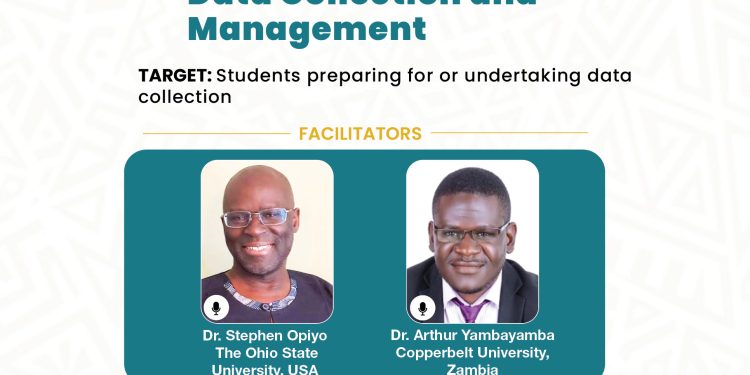
| Day 2 | 2. Data Collection and Management | Students preparing for or undertaking data collection | Revised research tool, sampling plan and data management checklist. | Main Facilitator: Dr. Stephen Opiyo, The Ohio State University, USA
Team Member: Dr. Arthur Yambayamba, Copperbelt University, Zambia
|
https://bit.ly/4z5aq5L
|
| Day 2
|
3. Scientific Writing, Presentation and Publication | Students approaching completion or who have completed research | Draft manuscript outline or section, journal shortlist and presentation outline. | Main Facilitator:
Dr. Charles Mulenga, Copperbelt University, Zambia Dr. Prudence Zimba, Levy Mwanawasa, Zambia |
https://bit.ly/4zPWU61
|
PREPARATION AND DELIVERY
- Sessions combine short facilitator inputs with guided exercises using students’ own research materials. The programme is an intensive clinic; continued supervision and practice will be needed.
- Before training, students should bring their proposal or thesis draft, supervisor comments, research tools or an anonymised dataset, as appropriate. Analysis participants should install the software selected by the facilitator in advance.
- Facilitators should select and circulate relevant open funding calls before Day 2 so resource mobilisation exercises use real requirements. Calls are to be confirmed before training.
- Resource mobilisation is open to all students but runs in parallel with two other streams. Share its materials and, where available, recordings with all participants, and arrange a follow-up funding clinic for those attending other streams.
- Each student leaves with a draft or revised research product and an action plan identifying the next task, a supervisor or mentor to consult, and a target date. Dates, venue and facilitators are to be confirmed.
DAY 1: 12th November 2026
DAY 1: RESEARCH DEVELOPMENT, ANALYSIS AND COMPLETION
08:00–17:00 | Three parallel streams | All durations shown in minutes
| Time CAT
(duration) |
Parallel session 1 Research Proposal DevelopmentRapporteur: Yamungu Alongo |
Parallel session 2 Thesis and Dissertation CompletionRapporteur: Selma Ndapewa |
Parallel session 3 Data Analysis and InterpretationRapporteur: Mayada Beshir |
|
| 08:00–08:30 (30 min) | OFFICIAL OPENING CEREMONY
Master of Ceremony: Professor Majaliwa J.G. Mwanjalolo |
|||
| Welcome Remarks
1. Dr. Florence Nakayiwa, Deputy Executive Secretary, RUFORUM 2. Professor Jacob Mwitwa, Vice Chancellor, Kapasa Makasa University 3. Professor Mathias Fonteh, RUFORUM Board Chair of P&D
|
||||
| 09:00–09:45 (45 min) | Research problem formulation: define the problem, research gap and justification. | Thesis structure: organise chapters and check institutional requirements. | Statistical software: set up the selected package, import data and check data readiness. | |
| 09:45–10:30 (45 min) | Literature review: search, evaluate and synthesise relevant evidence. | Results presentation: organise findings, tables and figures around objectives. | Quantitative analysis: descriptive statistics and selection of suitable statistical tests. | |
| 10:30–10:45 (15 min) | Health break | |||
| 10:45–11:30 (45 min) | Research objectives: formulate clear general and specific objectives. | Discussion: compare findings with literature and explain similarities and differences. | Modelling: select an appropriate model, check assumptions and interpret model outputs. | |
| 11:30–12:15 (45 min) | Research questions and hypotheses: align them with objectives and study design. | Discussion clinic: develop implications, limitations and contributions to knowledge. | Qualitative analysis: prepare transcripts and develop an initial coding framework. | |
| 12:15–13:00 (45 min) | Methodology (I): research design, study population and sampling. | Conclusions and recommendations: link conclusions to findings and objectives. | Coding and themes: practise coding, identify patterns and develop themes. | |
| 13:00–14:00 (60 min) | Lunch break | |||
| 14:00–14:45 (45 min) | Methodology (II): data collection tools, analysis plan and feasibility. | Referencing: accurate citations, reference management and consistency. | Visualisation: choose and create suitable charts, tables and thematic displays. | |
| 14:45–15:30 (45 min) | Research ethics: consent, confidentiality, integrity and approval requirements. | Responding to supervisor feedback: prioritise comments and prepare a response table. | Interpretation: relate results to research questions, uncertainty and study limitations. | |
| 15:30–15:45 (15 min) | Tea break | |||
| 15:45–16:30 (45 min) | Proposal writing clinic: integrate sections and review alignment and clarity. | Thesis completion clinic: revise a section and identify remaining analysis and writing tasks. | Analysis clinic: apply the methods suited to participants’ data and draft a results narrative. | |
| 16:30–17:00 (30 min) | Review proposal drafts and agree individual action plans. | Review revised sections and agree completion milestones. | Review analysis outputs and agree next steps. | |
DAY 2: 13th November 2026
DAY 2: FUNDING, DATA COLLECTION AND SCIENTIFIC COMMUNICATION
08:30–17:00 | Three parallel streams | All durations shown in minutes
| Time CAT (duration) | Parallel session 1 Resource Mobilisation and ManagementRapporteur: Yamungu Alongo |
Parallel session 2 Data Collection and ManagementRapporteur: Selma Ndapewa |
Parallel session 3 Scientific Writing, Presentation and PublicationRapporteur: Mayada Beshir |
|
| 08:00–08:30 (30 min) | OFFICIAL OPENING CEREMONY
Master of Ceremony: Professor Majaliwa J.G. Mwanjalolo |
|||
| Welcome Remarks
1. Dr. Florence Nakayiwa, Deputy Executive Secretary, RUFORUM 2. Professor Jacob Mwitwa, Vice Chancellor, Kapasa Makasa University 3. Professor Mathias Fonteh, RUFORUM Board Chair of P&D |
||||
| 09:00–09:45 (45 min) | Funding calls: identify an existing call, assess eligibility and review selection criteria. | Sampling: define the sampling frame, select a method and justify sample size. | Manuscript development I: structure the paper and define its central message. | |
| 09:45–10:30 (45 min) | Proposal development I: align the problem, rationale and objectives with the selected call. | Research tools: develop questionnaires, interview guides or observation checklists. | Manuscript development II: draft the title, abstract and introduction. | |
| 10:30–10:45 (15 min) | Tea break | |||
| 10:45–11:30 (45 min) | Proposal development II: outline methods, activities, partnerships and responsibilities. | Tool pretesting: test clarity, relevance and consistency; refine instruments. | Manuscript development III: write methods and present results clearly. | |
| 11:30–12:15 (45 min) | Proposal development III: specify outputs, outcomes, indicators and expected impact. | Research ethics: approvals, informed consent, confidentiality and responsible data handling. | Manuscript development IV: develop the discussion and conclusions. | |
| 12:15–13:00 (45 min) | Work planning and budgeting: prepare a realistic schedule and justify costs. | Data quality assurance: train data collectors, check completeness and address errors. | Journal selection and publication: assess scope, credibility, author guidance and publication ethics. | |
| 13:00–14:00 (60 min) | Lunch break | |||
| 14:00–14:45 (45 min) | Resource management: plan expenditure tracking, financial reporting and funder compliance. | Data management: organise files, create a codebook, set access controls and back up data. | Scientific presentations: structure a talk or poster and communicate key findings. | |
| 14:45–15:30 (45 min) | Proposal drafting clinic: assemble a concept note and budget for the selected call. | Data management practical: practise data entry, validation, documentation and secure storage. | Research dissemination: select audiences, messages and suitable communication channels. | |
| 15:30–15:45 (15 min) | Tea break | |||
| 15:45–16:30 (45 min) | Peer review: assess drafts against the call and revise weak sections. | Fieldwork planning clinic: integrate sampling, tools, ethics and quality checks into a collection plan. | Writing and presentation clinic: revise a manuscript section and practise a short presentation. | |
| 16:30–17:00 (30 min) | Review concept notes, evaluate learning and agree submission milestones. | Review data collection plans, evaluate learning and agree next steps. | Review draft products, evaluate learning and agree publication or presentation milestones. | |
[1] Oladimeji, O., Londani, M., Moyo, S., et al. (2026). Mentorship-infused initiatives for postgraduate research supervision in African higher institutions of learning: A systematic review and meta-synthesis protocol. BMJ Open, 16(1), e107670. https://doi.org/10.1136/bmjopen-2025-107670
[2] Japheth, N., Namubiru Ssentamu, P., Kyalo Wambua, B., & Jepkoech Kurgat, S. (2023). Strategies used for effective research supervision in the completion of postgraduate studies in selected universities of Uganda. Journal of the National Council for Higher Education, 10(2).
[3] Japheth, N., Namubiru Ssentamu, P., Kyalo Wambua, B., & Jepkoech Kurgat, S. (2023). Strategies used for effective research supervision in the completion of postgraduate studies in selected universities of Uganda. Journal of the National Council for Higher Education, 10(2).
[4] Japheth, N., Namubiru Ssentamu, P., Kyalo Wambua, B., & Jepkoech Kurgat, S. (2023). Strategies used for effective research supervision in the completion of postgraduate studies in selected universities of Uganda. Journal of the National Council for Higher Education, 10(2).
[5] Mireku, D. O., Bervell, B., Nyame, G., et al. (2026). Postgraduate thesis and dissertation supervision in higher education in the Sub-Saharan Africa region: A systematic review of a decade (2014–2024) literature. Discover Education, 5, 433. https://doi.org/10.1007/s44217-026-01383-3
[6] Oladimeji, O., Londani, M., Moyo, S., et al. (2026). Mentorship-infused initiatives for postgraduate research supervision in African higher institutions of learning: A systematic review and meta-synthesis protocol. BMJ Open, 16(1), e107670. https://doi.org/10.1136/bmjopen-2025-107670






[…] capacity and for developing the next generation of academics, researchers, professionals and leaders[1]. However, postgraduate training in many African higher education institutions continues to face […]
[…] capacity and for developing the next generation of academics, researchers, professionals and leaders[1]. However, postgraduate training in many African higher education institutions continues to face […]
[…] capacity and for developing the next generation of academics, researchers, professionals and leaders[1]. However, postgraduate training in many African higher education institutions continues to face […]