Beyond the Grain: How a TAGDev 2.0 UniPort Training Participant Is Transforming Rice into Value-Added Food Products

Nkem Vivian Ijeh, TAGDev 2.0 trained agro-entrepreneur, founder/CEO of Vivkem Foods.
By Chinyelu Irene Nwokolo
Through strategic institutional partnerships, training and exposure, the University of Port Harcourt’s (UniPort) TAGDev 2.0 Programme is helping to strengthen the capacity, visibility and growth opportunities of emerging agricultural entrepreneurs. The journey of Nkem Vivian Ijeh, founder of Vivkem Foods, offers a compelling illustration.
What if rice could be enjoyed not only as a meal served with stew or prepared as jollof, but also as a nutritious cereal taken with milk? For Nkem Vivian Ijeh, this is more than an interesting food idea. It is an expression of the innovation and entrepreneurial thinking driving her growing agro-processing business, Vivkem Foods.
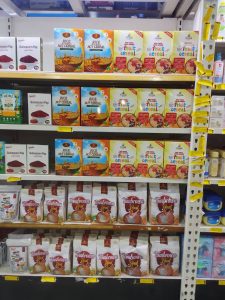
Her product, Rice with Mixed Nut Cereal, represents an alternative way of presenting and consuming one of Nigeria’s most important staple crops. By processing rice into a convenient cereal product, Nkem is demonstrating how agricultural commodities can move beyond their conventional uses to create new food options and opportunities for value addition.
Behind this innovation is the story of a woman who began a food-processing enterprise in her kitchen in 2018 with an initial capital of just ₦20,000 and has steadily worked towards building a recognised food brand. Today, she is the Managing Director and Chief Executive Officer of Vivkem Global Ventures Limited, which operates under the brand name Vivkem Foods.
Her journey is one of entrepreneurial determination, institutional support and the possibilities that emerge when innovation meets the right opportunities.
From a Kitchen Enterprise to a Growing Food Brand
Nkem’s entrepreneurial journey began with the production of Tom Brown Cereal. What started as a small-scale operation gradually developed into a wider food-processing enterprise, with eight additional products emerging from the original product. Today, Vivkem Foods has a range of nine products: Tom Brown Cereal, Rice with Mixed Nut Cereal, Oat-Meal with Mixed Fruit Cereal, Soybean Powder, Soymilk Powder, Banana Pap, Mixed Grain Pap, Date Fruit Powder and Granola.

The products reflect her interest in developing convenient food options from different agricultural ingredients while responding to consumer preferences and market opportunities.
The enterprise has also made progress in meeting product quality and regulatory requirements. According to Nkem, five of its products have received certification from the National Agency for Food and Drug Administration and Control (NAFDAC) and the Standards Organisation of Nigeria (SON). The company also holds Hazard Analysis and Critical Control Points (HACCP) certification.
The growth of the business is reflected not only in its expanding product range but also in its production, customer base and employment. Nkem reports that Vivkem Foods currently produces and sells approximately 1,300 packs of its products monthly. Its customer base comprises 25 stores and supermarkets, alongside approximately 35 regular individual customers.
The enterprise currently employs nine people, providing livelihoods while contributing to the development of a growing local food-processing business.
From an initial investment of ₦20,000 in 2018, Nkem estimates that the business has grown to a value of approximately ₦50 million in equipment, raw materials and finished products. This represents a remarkable progression from its modest beginnings and reflects the resources she has gradually invested in building the enterprise.
The Institutional Support Behind the Growth
An important part of Nkem’s journey has been her relationship with the Nigerian Stored Products Research Institute (NSPRI), where she is an official incubatee and has spent approximately three years.
She credits the institute with playing a significant role in the development of Vivkem Foods. In the early stages of her business, limited capital made it difficult to acquire the processing equipment and facilities required for expanded production. Through NSPRI’s incubation arrangement, she gained access to processing and drying facilities that enabled her to develop additional products and increase production beyond what she could initially achieve on her own.
The support has extended beyond access to equipment. Technical personnel at the institute have also provided guidance when she encounters production-related challenges, helping her improve her knowledge and approach to food processing.
For Nkem, this institutional support has been particularly valuable because her products require drying as part of their processing. Access to appropriate facilities has therefore been central to the development and diversification of her product range.
However, as the number of incubatees and other users of NSPRI’s facilities increases, access to some processing equipment, particularly dryers, has become more competitive. At times, limited availability affects her production schedules and ability to meet demand.
Nevertheless, the incubation environment has provided an important foundation for her enterprise as she works towards establishing an independent agro-processing facility.
Despite the progress recorded, Nkem recognises that the next phase of her entrepreneurial journey will require greater production capacity, improved logistics and increased control over her processing operations.
One of her major aspirations is to acquire her own agro-processing machinery and establish an independent production facility. This, she believes, will enable her to reduce dependence on shared facilities, manage production schedules more effectively and respond better to market demand.
However, achieving this ambition requires addressing some operational challenges that currently constrain the business. For instance, delays in accessing dryers interrupt production and affect the quantity of products she is able to supply to customers. The lack of an independently owned means of logistics also hinders the effective and timely movement of raw materials to the production facility and finished products to the market.
She further identified the need for additional processing and packaging equipment, including food-grade milling machines, grain sorting and washing machines, and packaging machines. According to her, these are among the essential equipment required to improve production efficiency, product handling and packaging as the business prepares for its next phase of growth. However, acquiring them remains a major challenge because of their high cost.
Beyond equipment and logistics, Nkem also acknowledges other business constraints. Some customers purchase products on credit and delay payment, affecting cash flow and the availability of funds for subsequent production.
While expanding her customer base remains important, she is conscious of the need to ensure that production capacity can meet any increase in demand. This has influenced her cautious approach to extensive online advertising, as she does not want to generate demand that the business may not yet be adequately equipped to satisfy.
Nevertheless, her ambition remains to strengthen the business, expand its production capacity and establish an independent agro-processing facility that can support more efficient operations, increased output and greater market reach.
Beyond the Individual Story: The TAGDev 2.0 Approach to Agricultural Transformation
Beyond Training: The TAGDev 2.0 Connection
Nkem’s engagement with the University of Port Harcourt’s Transforming African Agricultural Universities to Meaningfully Contribute to Africa’s Growth and Development (TAGDev 2.0 Programme) emerged through the strategic collaboration between the programme and NSPRI.
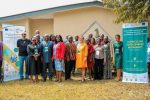
In April 2026, NSPRI invited its incubatees to participate in a two-day training organised by the University of Port Harcourt’s TAGDev 2.0 Programme in collaboration with the institute. Titled Equipping Agro-processors for Industry Compliance and Competitive Market Access, the training held on 9–10 April 2026 at NSPRI in Port
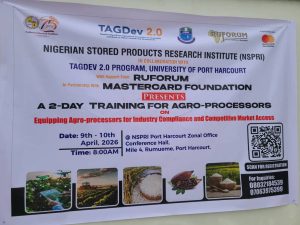
The programme provided an opportunity for agro-processors to strengthen their understanding of industry compliance and competitive market access. Although Nkem already had practical experience from running her business, she described the training as an opportunity to acquire new knowledge and refresh what she had learned through years of entrepreneurship.
But the significance of the engagement extended beyond the training sessions.
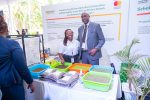
On the second day of the TAGDev 2.0 training for agro-processors, Nkem brought some of her products for display. Among them was Rice with Mixed Nut Cereal, whose packaging, branding and innovative use of rice attracted attention.
Unlike conventional rice products, her cereal offered a different food experience, presenting rice as a value-added product that could be consumed with milk. Its display provided an opportunity to draw attention to the potential of transforming familiar agricultural commodities into alternative food products.
This was one of the opportunities through which the strategic partnership between TAGDev 2.0 and NSPRI began connecting Nkem’s entrepreneurial innovation to a wider agricultural development platform.
When Innovation Meets the Right Platform
A defining moment in the growing visibility of Nkem’s product came in July 2026, during the visit of a Regional Universities Forum for Capacity Building in Agriculture (RUFORUM), delegation to Nigeria for the Association of Deans of Agriculture in Nigeria (ADAN) Conference.
It was at this exhibition that Professor Patrick Okoli and Professor Anthony Egeru noticed Nkem’s Rice with Mixed Nut Cereal.
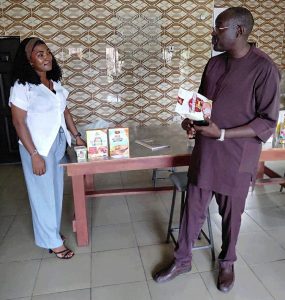
Professor Patrick Okori engaging Nkem Vivian Ijeh at an exhibition in Nigeria
The product’s branding and packaging caught his attention, particularly its innovative transformation of rice into an alternative value-added food product rather than its conventional presentation as a staple meal.
The encounter brought the product to the attention of a wider institutional audience and created an opportunity for its innovation to be recognised beyond the immediate incubation environment.
The visibility gained at NSPRI was subsequently extended when RUFORUM and its delegates showcased Vivkem Foods’ product at the RUFORUM exhibition booth during the 9th Africa Agriculture Science Week (AASW) and 10th Forum for Agricultural Research in Africa (FARA) General Assembly in Abuja in July 2026. Although Nkem did not personally attend the conference, the opportunity provided by RUFORUM enabled her product to be presented to a wider audience of agricultural research and development stakeholders.
This progression illustrates an important dimension of institutional collaboration: opportunities created through one engagement can open doors to other platforms where emerging entrepreneurs and their innovations can gain further exposure.
Taking Local Innovation to Wider Agricultural Platforms
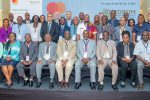
Nkem’s engagement with TAGDev 2.0-linked activities also extended to the Association of Deans of Agriculture in Nigeria (ADAN) Conference, held from 20–24 July 2026.
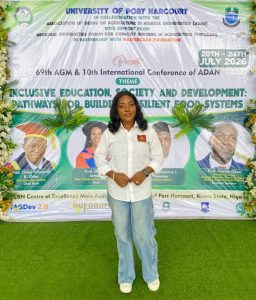
Organised in partnership with RUFORUM and the TAGDev 2.0 Programme, the conference was themed Inclusive Education, Society and Development: Pathways for Building Resilient Food Systems.
Her participation provided another opportunity to connect her entrepreneurial experience with discussions and engagements involving agricultural education, research, enterprise development and food systems.
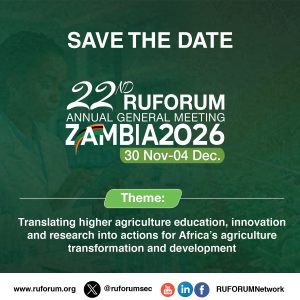
Looking ahead, Nkem has also been invited to the 22nd RUFORUM Annual General Meeting, scheduled for 30th November – 4th December 2026. She intends to attend with her products and use the opportunity to exhibit them at the gathering.
For Vivkem Foods, this represents another opportunity to present its innovations to a wider agricultural development community. For Nkem, it is a chance to continue building connections and increasing awareness of the products she has developed.
The Next Chapter: From Incubation to Independence
Nkem’s experience offers an important perspective on the role of strategic partnerships in agricultural enterprise development.
Her business was established in 2018, long before her participation in TAGDev 2.0 activities. NSPRI has provided the incubation environment, access to processing facilities and technical guidance that have supported its development. Through the collaboration between NSPRI and the University of Port Harcourt’s TAGDev 2.0 Programme, she has also gained access to training and opportunities for product exhibition and wider institutional engagement.
The story therefore goes beyond the participation of one entrepreneur in a training programme. It illustrates how agricultural development initiatives can connect existing enterprise efforts with relevant institutions, knowledge, professional networks and platforms for visibility.
Implemented by the University of Port Harcourt with support from RUFORUM and in partnership with the Mastercard Foundation, TAGDev 2.0 is committed to strengthening the contribution of agricultural universities to Africa’s development. Through its engagement with agricultural value chains, including rice and aquaculture, as well as its focus on skills development, youth employment and enterprise opportunities, the programme seeks to connect agricultural knowledge with practical pathways for economic and social development.
The experience of Vivkem Foods demonstrates one way this approach can work: bringing together an agricultural research institution, a university-led development programme and a regional agricultural network to create opportunities for an emerging entrepreneur’s innovation to gain wider recognition.
For Nkem, the journey continues. From the first batches of Tom Brown produced in her kitchen to a growing range of nine food products, a monthly sales volume of approximately 1,300 packs, a customer network spanning stores, supermarkets and individual buyers, and a workforce of nine, she is steadily building an enterprise around the possibilities of agricultural value addition.
And as she prepares to take her products to the 22nd RUFORUM Annual General Meeting scheduled for 30th November – 4th December 2026, her story carries a message that extends beyond one business: when agricultural institutions collaborate strategically, they can do more than transfer knowledge. They can help connect innovation to opportunity, strengthen emerging enterprises and create platforms through which local solutions gain wider visibility.
That is the promise of going beyond the grain and the kind of agricultural transformation that TAGDev 2.0 is working to advance.
A Message of Appreciation
Reflecting on her entrepreneurial journey and the opportunities she has received, Nkem expressed profound appreciation to the institutions that have supported her business development and provided platforms for learning, exposure and growth. She particularly acknowledged the Nigerian Stored Products Research Institute (NSPRI) for its incubation support, access to processing facilities and technical guidance, which have contributed significantly to the growth of Vivkem Foods. She also extended her heartfelt gratitude to the University of Port Harcourt’s TAGDev 2.0 Programme for the training and opportunities to showcase her products and connect with wider agricultural development platforms. She appreciated RUFORUM for its continued support and for creating additional opportunities to promote her products, including showcasing them at the FARA Conference in Abuja. Nkem equally expressed her appreciation to the Mastercard Foundation for its partnership and support towards the TAGDev 2.0 Programme, which is creating opportunities for agricultural enterprise development and the advancement of emerging entrepreneurs.
She described her appreciation to these institutions as a recognition of the important role that collaboration, institutional support and access to opportunities play in helping entrepreneurs develop their businesses and pursue their ambitions.