TAGDev Universities put climate-smart technology in the hands of nearly 19,000 farmers in six months
Across Africa, universities are increasingly demonstrating that their contribution to society extends far beyond lecture halls, academic publications and the graduates they produce. From strengthening community seed systems and equipping young people with entrepreneurial skills to introducing climate-resilient agricultural technologies, universities are translating research and innovation into practical solutions that improve livelihoods. Through the TAGDev 2.0 consortium, fifteen member universities have directly reached 18,714 farmers with climate-adaptive technologies, improved seed systems and agricultural production knowledge, demonstrating the growing role of higher education institutions in addressing challenges faced by farming communities.
This achievement reflects a broad range of interventions designed to strengthen agricultural productivity, build resilience to climate change and create economic opportunities, particularly for young people and vulnerable communities. Across participating institutions, these efforts include establishing seed multiplication gardens, promoting disease-resistant crop varieties, supporting youth-led agricultural enterprises and rehabilitating degraded agricultural landscapes. Together, these initiatives demonstrate how universities are connecting research, innovation and community engagement to deliver measurable societal impact.
Central to this approach is a commitment to understanding the needs of farming communities before introducing interventions. At Egerton University, baseline studies across cassava, potato and dairy value chains assessed farmers’ socio-economic conditions and production challenges to inform targeted support. The university has already reached 2,660 farmers and aims to support an additional 68,500 through its Agribusiness and Skills Enterprise Centre. Similarly, Haramaya University conducted formative and needs assessments across three districts and three kebeles in Ethiopia, identifying opportunities to strengthen community seed systems and improve the organisation of horticultural traders. In Ghana, the University of Cape Coast completed five needs-assessment reports covering 18 districts across four regions, focusing on tomato, cassava, sweet potato and pineapple value chains.
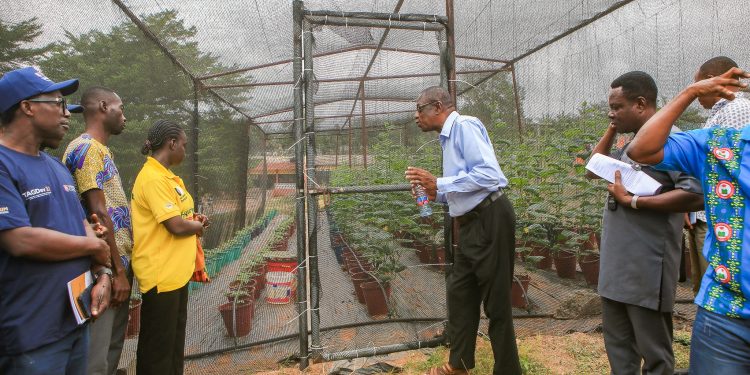
Strengthening access to quality planting materials has also emerged as a major priority across the consortium, particularly as farmers contend with changing climatic conditions and increasing production risks. The University of Cape Coast has established sweet potato, yam and cassava seed gardens alongside six shade-net greenhouses. These interventions are supporting community seed systems working towards production targets of 300 tonnes of pineapple, 600 tonnes of cassava, 150 tonnes of sweet potato and 20 tonnes of yam planting material. In Nigeria, the University of Port Harcourt, in partnership with Value Seeds Ltd, produced eight tonnes of open-pollinated rice seed for distribution across six planting sites ahead of the July 2026 planting season.
Complementing these efforts, the National University of Agriculture organised a cassava seed growers’ workshop to strengthen certified seed production and pest management practices. Great Zimbabwe University, working as an Africa University partner, trained 20 lead farmers in seed handling and storage across the Chivi and Buhera districts. These interventions are contributing to more reliable seed supply systems while strengthening farmers’ capacity to sustain agricultural production under increasingly unpredictable conditions.
Beyond improving agricultural productivity, TAGDev 2.0 universities are extending their interventions to communities facing significant social, economic and environmental challenges. In Malawi, the Malawi University of Science and Technology distributed 3,480 fruit seedlings to 142 young people and assessed degraded land for agroforestry rehabilitation within Dzaleka Refugee Camp. Originally designed to accommodate 10,000 people, the camp now hosts an estimated 57,000 to 60,000 refugees, placing considerable pressure on available land and natural resources. The university’s intervention seeks to support environmental restoration while creating opportunities for more sustainable agricultural livelihoods.
In northern Uganda, Gulu University has similarly demonstrated the importance of inclusive agricultural development, reaching 362 farmers, including 38 people with disabilities, through training in vegetable production and safe agrochemical use. Two youth-led agribusinesses supported by the university, Marlonyo and New Blessing Produce Ltd, have extended agricultural training and market linkages to a further 229 farmers. These initiatives illustrate how universities can contribute to more inclusive development by ensuring that agricultural knowledge and technologies reach communities that are often underserved.
Young people are also increasingly taking on roles as agricultural service providers and entrepreneurs rather than remaining solely beneficiaries of university-led interventions. At the University of Eldoret, youth have been trained to operate hand-driven planters, enabling them to provide affordable planting services to farmers while generating income. This work forms part of wider collaboration with the Endorois women’s group to strengthen community seed systems and support enterprises such as Magina Agrovet and Mzuri Organics.
At Gulu University, rice value-chain mapping has identified opportunities for youth participation in seed businesses, aggregation, agricultural waste valorisation and processing. The university has engaged 179 young farmers in Nwoya and 307 in Otuke around climate-resilient rice varieties, creating pathways for greater youth involvement in agricultural value chains. Meanwhile, the University of Cape Coast is supporting 200 youth seed-producer enterprises, with nearly equal participation by young women and men, through entrepreneurial and technical training. These interventions demonstrate the potential of agricultural innovation to create employment opportunities while addressing farmers’ needs for accessible products and services.
Recognising that sustainable agricultural transformation requires collaboration beyond university campuses, consortium members are also strengthening partnerships with government institutions, research organisations, private enterprises and farming communities. In Morocco, Mohammed VI Polytechnic University organised a Living Lab workshop at the Achhab Naama Cooperative in Youssoufia Province, bringing together the National Office for Food Safety (ONSSA), the National Institute of Agricultural Research (INRA), the regional agriculture directorate, an innovation hub and cooperative members. The engagement focused on raising farmers’ awareness of opportunities associated with medicinal and aromatic plants.
In Cameroon, the University of Bamenda conducted needs assessments in Nkambe and Santa, identifying irregular rainfall, pest pressure and limited access to quality seed as major agricultural constraints. The findings are informing partnerships with Experience Incorporated Cameroon and the Nkambe Council farm to strengthen seed multiplication and promote climate-resilient agricultural practices. Such collaborations are helping universities connect research-based solutions with the institutions and community structures needed to support their wider adoption.
Alongside technology dissemination and community engagement, participating universities are investing in evidence generation to strengthen programme implementation and measure results. Université du Sine Saloum El-Hâdj Ibrahima NIASS (USSEIN) deployed 137 trained youth and alumni enumerators, using KoboToolbox to collect information from 708 value-chain actors as part of peanut and horticulture diagnostics. In Uganda, Uganda Martyrs University assessed maize seed systems in Mpigi through KoboCollect surveys involving 144 farming households, six focus-group discussions and twelve key-informant interviews. Sokoine University of Agriculture is also preparing a baseline survey to assess climate adaptation and mitigation practices, providing further evidence to guide subsequent interventions.
These assessments are strengthening the consortium’s ability to identify agricultural challenges, design responsive interventions and document changes in farming practices, productivity and livelihoods. They also reinforce the importance of evidence-based decision-making in ensuring that university-led innovations remain relevant to the communities they are intended to serve.
The progress recorded across the fifteen TAGDev 2.0 universities highlights a broader shift in how higher education institutions contribute to Africa’s agricultural transformation. By combining research, practical training, entrepreneurship, community engagement and strategic partnerships, universities are demonstrating their capacity to address real development challenges.
With 18,714 farmers already reached, the consortium’s contribution is increasingly visible not only in academic achievements, but also in improved access to agricultural technologies, stronger community seed systems, emerging youth enterprises and greater opportunities for vulnerable communities. These results reinforce the importance of universities as drivers of agricultural innovation and sustainable development, with their impact ultimately reflected in the value they deliver to society