Gender blindness is costing African agriculture billions. Universities and research networks must lead the fix
October 22–26, 2026 | NAIROBI, Kenya — Africa’s agricultural gender gap is usually described as a problem in the field: women farm smaller plots, use less fertiliser and reach markets less often. Growing evidence points further upstream, to the universities and research institutes that train Africa’s scientists and design its technologies.
Speaking at the AWARD GREAT workshop in Nairobi, Prof. Anthony Egeru framed the issue in economic terms. “Gender is not a cost of doing research. Gender blindness is,” he told researchers.
The economics are no longer in dispute
Women make up 49% of the agrifood workforce in sub-Saharan Africa, according to the 2025 Status of Women in Agrifood Systems in Sub-Saharan Africa report by FAO, the Natural Resources Institute and AWARD. Yet in 28 of 33 countries with data, men are more likely to hold secure land rights.
The result is a measurable productivity penalty. FAO estimates a 24 percent gap between women and men farming plots of equal size. A 2026 World Bank study across 12 African countries found gaps from 7 percent in Guinea to 77 percent in Chad, driven by unequal access to labour, inputs, high-value crops and digital tools, not ability.
Closing the gap pays. A UN Women, UNDP, UNEP and World Bank study valued the annual gain at about US$100 million in Malawi, US$105 million in Tanzania and US$67 million in Uganda, with later estimates of US$1.1 billion for Ethiopia and US$9.3 billion for Nigeria. Globally, FAO estimates nearly US$1 trillion in added GDP and 45 million fewer food-insecure people.
| BY THE NUMBERS | |
| 49% | Share of sub-Saharan Africa’s agrifood workforce that is female |
| ~1 in 4 | Agricultural researchers in the region who are women |
| 7% | Women’s share of leadership in African agricultural research institutions |
| 24% | Productivity gap between women and men farming plots of equal size (global) |
| US$1 trillion | Global GDP gain from closing farm productivity and wage gaps |
| US$56–300bn | Illustrative farm output forgone in the region, 2026–2035, if gaps persist |
A cost that grows with the economy
Scenario analysis presented at the workshop shows why delay is expensive. Under illustrative assumptions, sub-Saharan Africa could forgo US$56–300 billion in farm output between 2026 and 2035 if gender gaps persist. Faster growth makes the loss larger: an economy expanding at the 6 percent CAADP target loses about 30 percent more than one growing at 2.5 percent.
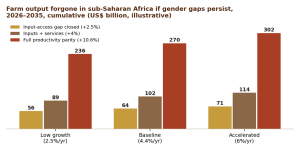
Source: author’s illustrative calculation based on World Bank Africa’s Pulse (2025), FAO (2011, 2023) and World Bank (2026). Assumes regional agricultural value added of about US$340 billion in 2025, with gains phased in linearly.
Climate change widens the gap: FAO’s Unjust Climate report found female-headed rural households lose 8 percent more income to heat stress and 3 percent more to floods than male-headed ones.
Why universities, and why now
Technologies reflect the people who design them. AWARD reports that only about a quarter of agricultural researchers in sub-Saharan Africa are women, falling to 7 percent in research leadership. Regional networks offer scale that individual universities cannot. RUFORUM, a network of 175 universities in 40 African countries, reports that women make up over 40% of the more than 2,000 postgraduate students it has supported, and its Gender, Inclusion and Safeguarding Framework is helping universities accelerate from policy to practice.
AWARD and GREAT: building the gender-responsive pipeline
Nairobi-based African Women in Agricultural Research and Development (AWARD) has become one of the continent’s strongest actors against gender blindness. Its fellowships have reached more than 1,800 beneficiaries, while programmes such as Gender-Responsive Agricultural Research and Development (GRARD) and the Gender Responsive Agriculture Systems Policy (GRASP) fellowship carry the agenda into institutions and policy.
Its newest initiative, the Gender-Responsive and Women-Led Research and Development (GROW) programme, is implemented with Gender-Responsive Researchers Equipped for Agricultural Transformation (GREAT), Makerere University and Cornell University. GREAT has trained 346 researchers in gender-responsive methods since 2016. GROW targets 48 women breeders across two cohorts and helps research organisations and universities in Ethiopia, Kenya, Nigeria and Uganda, including Egerton, Makerere and Mekelle universities, embed gender in breeding curricula.
“AWARD builds the scientists, GREAT builds the skills and RUFORUM builds the institutions,” Prof. Egeru said. “Together, that is a pipeline.”
Where the investment should go
Scale what works. Extend the GROW and GREAT model from four countries to RUFORUM’s wider university network.
Gender-competent graduates. Make gender analysis a core competency in agronomy, breeding, engineering and data science curricula.
A pipeline to leadership. Expand women-targeted PhD assistantships, research grants and mentoring that move women into principal investigator and dean roles.
Shared data. Build a continental observatory of sex-disaggregated data on students, staff and research outcomes.
Gender-responsive innovation. Fund labour-saving tools, climate-adaptive practices and AI advisory services designed for women farmers.
Looking ahead to 2035
As artificial intelligence, climate finance and continental free trade reshape agriculture, the institutions that train Africa’s scientists will decide whether new technologies narrow gender gaps or entrench them. RUFORUM’s 22nd Annual General Meeting in Zambia, from 30 November to 4 December, offers an early platform for vice-chancellors, AWARD and funders to turn these priorities into shared commitments.
“Every year we wait, the bill gets larger,” Prof. Egeru said. “Closing the gender gap in our universities is how we stop paying it.”