Entrepreneurship training lures graduates into full time farming
By James Mphande, TAGDEV 2.0 Communications Lead at Malawi University of Science and Technology (MUST)
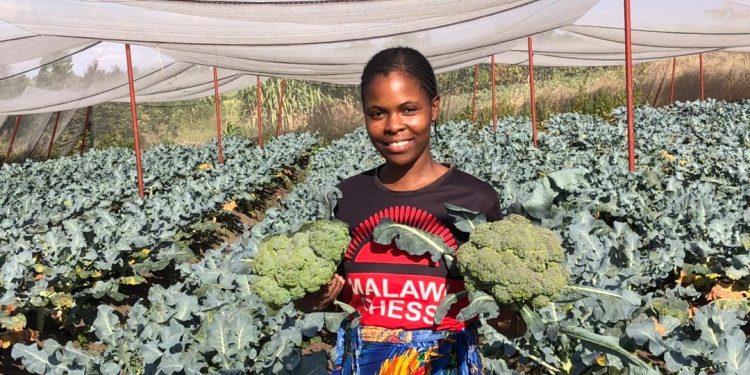
Elina Chitulu is defying long-held beliefs about farmers in Malawi: less educated, old, and not embracing new technologies for scale,
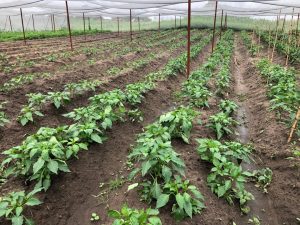
At just 22, holding a Bachelor’s degree in Journalism and practising modern horticulture in solar powered irrigated shed net houses over a one-hectare piece of land in Sakhuta Village in M’bwatalika area in the outskirts of Malawi’s capital, Lilongwe, Elina is rewriting farming, and in a big way.
On this sunny midday, Elina, with six (6) other youthful partners aged between 22 and 28, who graduated last year in different fields from the Malawi University of Business and Applied Studies (MUBAS), was found at their farm, working. Not supervising work as most youths their age, education and social standing, would.
“We are doing 90 percent of the work by ourselves. You can see the blisters in our hands. But we are determined to make farming our career and so far, there is no room for return,” she said of her team made up of Jomo Kaira, Maxmass Grey, Owen Khomba, Praise Manase, Habib Steven and Owen Phiri.
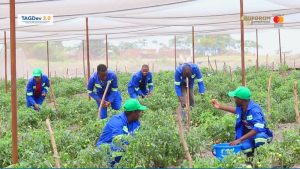
The team from Green Gold Enterprises in the field
Growing up in Mpinganjira Village in the lakeshore district of Mangochi, Elina’s dream was to become an international journalist, drawing inspiration from then BBC Focus on Africa’s Kenyan journalist, Sophie Ikenye. Her dream appeared to come true when she was selected to MUBAS to study journalism. She even lived her dream through internship at a local private TV station, Angaliba.
“All that changed when I was exposed to entrepreneurship while in my final year in college. With a team of likeminded students, we bid for an FDH Bank entrepreneurship grant, which we won. As we waited for the results of that competition, we started reading about entrepreneurship and meeting people who were into entrepreneurship, including Charis Farm,” said Elina.
“The news about our winning coincided with an entrepreneurship training organised by the Malawi University of Science and Technology (MUST) under the Transforming African Agricultural Universities to Meaningfully Contribute to Africa’s Growth and Development (TAGDEV 2.0) programme. The training eliminated any doubts on what we wanted to do. It gave us the impetus to forge ahead and here we are doing what we want to do as a career, and we want to do it professionally.”
With four shed net houses, the team which is operating as Green Gold Enterprises, is growing high value crops such tomatoes, onions, cori flower, broccoli, bell peppers, carrots, water melons, spinach and lettuce.
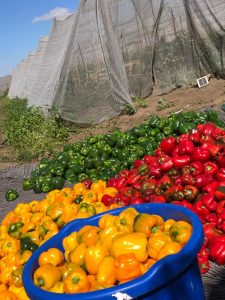
The produce from Green Gold Enterprise
With diverse professional backgrounds of three geological engineering graduates, two entrepreneurship degree holders and one journalist, Elina said with funding from the grant available, the agriculture skills acquired and entrepreneurship training mastered, they now want to lead the way for the youth to look at agriculture as a more lucrative business than ever before.
“From what we have gathered through the TAGDev 2.0 entrepreneurship training, is that, farming is good business if you are doing it right, focusing on the right crops, timing your planting to cultivate at peak times and using modern farming methods and irrigation to ensure consistent supply across the year,” Elina said, adding that they have now acquired enough agriculture knowledge to sustain the business and practise modern agriculture practices, including technology application.
“Through partnerships with the likes of Charis Farm, we already have a market for our products. This is not an ordinary market, we are talking about Malawi’s major supermarkets, hotels, restaurants and individuals. We started small on a rented piece of land, but we are seeing growth and soon we will have our own land.”
According to Elina, the team members are no longer worried with job hunting.
“You see that we are staying in the heart of a rural area where most of the urban amenities are not available. Even access to newspapers, internet and TV is limited. When we see adverts for job vacancies that align with our academic qualifications, we are not moved. We stopped applying for jobs because our aim is to soon start advertising for jobs for fellow youths to join us as our employees. We are looking at creating employment and not job hunting,” said Elina.
She said the TAGDEV 2.0 entrepreneurship training from MUST is a useful platform for youths across the country who are spending sleepless nights looking for job opportunities.
“Sometimes we look very far for solutions when the answer is near us. The first step is for the youth to open up and be ready to get dirty by looking at the various challenges people in their communities are facing and innovate to bring solutions to such challenges. It could be outside one’s comfort zone but that is where opportunities lie,” added Elina.
She said with many old-timers willing to mentor the youth in entrepreneurship and agriculture and the many available webinars and trainings, there is no excuse for the youth to continue crying for opportunities.
So far, the team’s entrepreneurship endevours have not only benefited them from their four harvest cycles this far, people around M’bwatalika and Lilongwe are also being impacted. For the team, the harvests have been good and with reliable markets, the financial gains have been beyond expectation. People, especially youths in the M’bwatalika community now have a place to find pieceworks and earn some money.
“We have four permanent workers from the community with two helping with farm operations such as tilling, watering, spraying etc, and the other two working as security guards. But we have many more youths from the community employed at peak periods of our growing cycles,” she said.
Not only that, as the youth work in the farm, they are also learning modern farming methods which they will soon employ in their own gardens, agriculture being the main economic stay of the area.
On the other hand, consumers in Lilongwe City and surrounding areas now have a steady source of quality horticultural products.
“I might have wanted to be a journalist but my true calling is in entrepreneurship through farming. Thanks to extension services, and the TAGDEV 2.0 programme, to realise our true calling. Our eyes are now set on diversification but within agriculture by going into value addition,” said Elina, the journalist now turned commercial farmer.