From Security to Sovereignty: Why Africa Needs More Than a Full Plate
By Samantha Ainembabazi
At the 21st RUFORUM Annual General Meeting in Botswana, the formal conversations focused on familiar terrain: yields, inputs, access, scale. But at coffee breaks and in corridors, a different conversation kept surfacing, one that felt too uncomfortable for the main sessions: the infamous debate of food sovereignty versus security.
That debate reveals a critical distinction. Food security asks: Do people have enough to eat? Food sovereignty asks: Do people control what they eat, how it’s grown, who profits, and what happens to the surplus? It extends to how the food is grown and what you can do with the food supply. The first is about volume. The second is about power. Food security can be achieved while leaving farmers dependent on external seed suppliers, locked into exploitative pricing, and vulnerable to market manipulation. Food sovereignty insists on self-determination across the entire food system—from seed selection to consumption.
We can talk about feeding Africa all day—improved yields, wider access, better inputs. But if our farmers don’t own their seeds, control their supply chains, or set their prices, we’re building someone else’s empire on our soil. Consider the absurdity: a farmer growing food on African land, forced to buy seeds from foreign multinationals, selling harvests at prices he or she didn’t negotiate, into supply chains the farmer doesn’t influence. Feeding the world but remaining economically vulnerable.
Without preservation technology, up to 40% of smallholder farmers’ and vendors’ produce spoils before reaching market (FAO, 2019). Across sub-Saharan Africa, post-harvest losses account for approximately $4 billion annually (World Bank, 2020). Farmers must sell fast at whatever price the first buyer offers because their produce cannot wait. No leverage, no bargaining power, no time to seek better markets. They grow more food and earn less power.
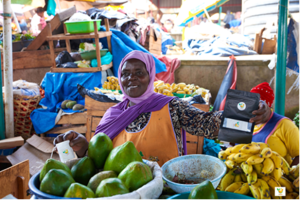
Picture a 36-year-old mango market vendor with three children to look after. Getting her produce an extra week means she’s no longer forced to sell at the first buyer’s price. She can wait, plan, compare markets, supply cooperatives, even access export channels that were never available before because her produce couldn’t survive the journey. She moves from reactive to strategic—a shift that’s deeply powerful in giving rise to food sovereignty at ground level.
Post-harvest loss is framed as a logistics problem—inadequate cold chain, poor transportation, insufficient storage. But these are symptoms of a deeper control issue. When farmers cannot preserve what they grow, they surrender control the moment produce leaves the ground. The system is often designed this way because farmer dependency creates profitable opportunities for middlemen who step into the power vacuum created by perishability.
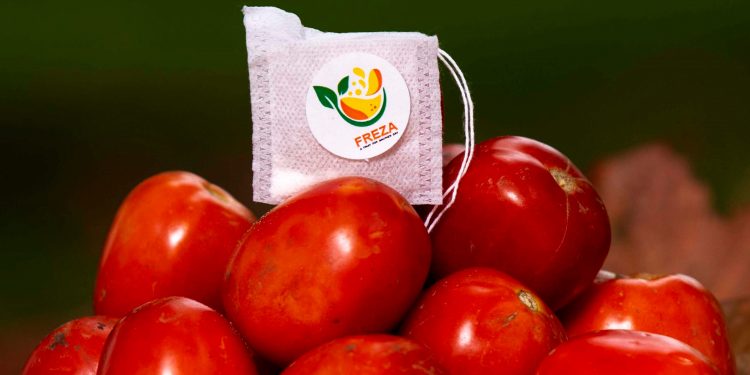
This is where technology like Freza’s organic nanotechnology sachets becomes infrastructure for sovereignty. Freza Nanotech, a Ugandan Agritech company operating across East Africa, has developed a non-toxic post-harvest preservation solution in bio-degradable packaging that extends the shelf life of fruits and vegetables by 14 to 31 days without refrigeration, with the product dispensed in sachets, bags, stickers and pods. The product is currently pilot testing in markets across Uganda and looking to expand to Kenya, Rwanda and Tanzania. The sachets work by inhibiting about 10 different enzymatic processes responsible for deterioration—naturally, without harmful chemicals, with one sachet treating about five kilograms of average-sized fruits or vegetables. A farmer adds a sachet to his or her harvest and gains something systematically denied before: time.
Freza’s journey itself reflects a broader ecosystem of support for African innovation. The company was supported through a partnership between RUFORUM and the Ministry of Science, Technology and Innovation under the Office of the President (Uganda), through the Commercializing Academic Research Initiative (CARI), which enabled the validation of its innovations. It is currently being accelerated with support from RUFORUM under its partnership with the Mastercard Foundation through the Transforming African Agricultural Universities to Meaningfully Contribute to Africa’s Growth and Development (TAGDev 2.0) program – an effort designed to bridge research, enterprise, and impact across the continent.
Time in this case is sovereignty. When the mango vendor extends shelf life by a week, she fundamentally alters her market position. She can wait, plan, negotiate with cooperatives, access export channels previously unavailable. She moves from reactive crisis management to strategic market participation—from price taker to price influencer, from desperation to choice.
The effects ripple through the value chain. For retailers: less waste, more consistent quality, wider sourcing range. For families: what arrives is what a farmer chose to send, not what happened to survive. Smallholder farmers gain the same temporal leverage that previously belonged only to well-capitalized players. But it goes beyond shelf-life extension to value addition. When farmers can preserve their harvest, they gain the time and flexibility to process raw produce into higher-value products—dried fruits, purees, packaged goods—rather than selling everything fresh at the lowest price point. This is how we truly utilize the food we produce, keeping more value within farming communities.
At the national level, many African countries spend billions importing food that could be grown domestically, often importing processed versions of crops they export raw. This creates double dependency: reliance on external suppliers and integration into global commodity chains on the least profitable terms. Food import bills drain foreign exchange and expose countries to global price shocks.
The conversation of food sovereignty becomes more than an agricultural issue—it’s a fiscal strategy. When African countries produce, preserve, process, and distribute their own food domestically and regionally, they reduce import dependence, retain value within their economies, and build resilience against shocks. For countries struggling with debt, this represents a pathway toward economic self-determination. You cannot build economic sovereignty on food dependency.
Feeding ourselves is survival. Controlling how we feed ourselves is transformational. The question isn’t whether Africa can produce enough food—it’s whether African farmers, communities, and nations will control the systems through which that food is grown, preserved, processed, distributed, and consumed. The answer will determine not just what’s on our plates, but who holds power over our futures. Increasingly, the tools to build that answer are emerging from African innovators building the infrastructure of sovereignty one solution at a time.
References
Food and Agriculture Organization of the United Nations (FAO). (2019). The State of Food and Agriculture 2019: Moving Forward on Food Loss and Waste Reduction. Rome: FAO.
World Bank. (2020). Reducing Food Loss and Waste in Sub-Saharan Africa: An Action Framework. Washington, DC: World Bank Group.