CLOSING THE AGM WITH CLARITY: FROM CONCLUSION TO ACCELERATION
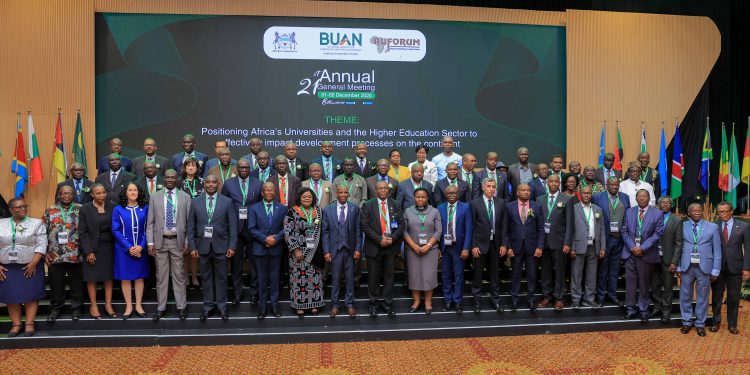
The 21st RUFORUM Annual General Meeting (AGM) convened in Gaborone, Botswana from 1st – 5th December 2025, set the scene for renewed commitment to doing things differently in repositioning Africa’s universities as engines of transformation. Guided by the theme “Positioning Africa’s Universities and Higher Education Sector to Effectively Impact Development Processes on the continent,” the AGM brought together 1,112 participants (34% female) from 45 countries, among them, government ministers, 85 Vice Chancellors and Deputy Vice Chancellors, senior university leaders, researchers, industry players, students and development partners. Together, they advanced concrete actions to strengthen the role of Africa’s higher education in accelerating agri-food systems transformation aligned with Agenda 2063.
The conference delivered four key results-oriented priorities:
- Strengthening cross-sector collaboration to expand university capacity and enhance their contribution to Africa’s and the global development agenda.
- Identifying actionable opportunities to scale up science, technology, and innovation capabilities across RUFORUM member universities.
- Defining pathways for achieving Agenda 2063’s Second Ten-Year Implementation Plan target of producing 100,000 PhDs.
- Establishing practical mechanisms for shared training and leadership development programs to prepare the next generation of agri-food system transformers.

participants during a round table discussion
The Pre-AGM plenary sessions predominantly focused on capacity building within the SADC region and more specifically Botswana in areas of scholarly writing, resource mobilization and data science and management. But most importantly a trailblazing hackathon targeting youth entrepreneurs, who were exposed to business principles and the fundamentals of investment. Three exceptional young innovators emerged as winners, receiving awards to help scale their solutions. The AGM reaffirmed the conviction that Africa’s future depends on the strength, vision, and agility of its higher education institutions.
Deliberations from the more than 14 sessions of the AGM focused and outlined a call to action in the following key areas:
- Changing the Landscape for Transformative Education
Acknowledging that current training systems remain misaligned with labour market expectations, leaving many graduates underprepared and relatively unable to meet their own and employer’s needs.
Therefore, there is a need to re-examine how universities in Africa are educating and preparing young people and adopt Transformative education – education that is contextual, relevant, digitally enabled, and aligned with 21st century market needs.
With Africa poised to become the world’s largest reservoir of young people by 2030, universities on the continent must accelerate the transition towards 4th-generation universities, which integrate teaching, research, innovation, entrepreneurship, and community impact. Higher education systems must adapt and scale.
With connectivity expected to reach over 1.1 billion Africans by 2029, universities must seize digital opportunities to position graduates for regional and global labour markets. They must respond to the accelerating impact of artificial intelligence, robotics, and digital tools on the world of work and integrate digital literacy, data science, and emerging technologies into teaching and research.
- Investment in Research, Development, and Innovation
Acknowledging that the level of investment in research and development (R&D) across the continent is low. Africa invests only 0.6% of GDP in R&D compared to the global average of 1.97%, which limits innovation, technology transfer, and competitiveness. Evidence has shown the high return on investment for PhD training and that investments in research is a key driver for economic growth and societal transformation.
Governments in Africa need to step up to the continental commitment to increase strategic investments in research, support to innovation hubs, strengthen intellectual property systems, and foster industry-academia partnerships.
- Agri-food System Transformation
Acknowledging that Agriculture remains Africa’s most strategic sector, with the potential to become a trillion-dollar industry by 2030. Yet productivity is constrained by weak value addition, climate vulnerabilities, limited youth involvement, and underdeveloped innovation ecosystems. Africa’s 65% share of the world’s remaining arable land presents immense opportunities if leveraged through robust science, youth participation, and responsive educational models.
The AGM called for universities to play a more assertive role in driving agri-food system transformation by co-creating relevant technologies thereby, strengthening value chains, promoting local processing, and building climate-resilient systems, that further target populations in conflict and post conflict areas.
- Strategic Partnerships and Collective Action
Acknowledging that RUFORUM is a growing network – currently spanning 175 universities in over 40 countries. It was recognized as an influential platform for collaboration, capacity strengthening, and joint action as agri-food systems transformation cannot occur in isolation. Partnerships among universities, governments, the private sector, development agencies, and international institutions is therefore essential for scaling innovations, mobilizing resources, and delivering impactful solutions.
Drawing lessons from global partners in Europe, Asia and the USA, the AGM underscored how universities can leverage partnerships to strengthening incubation and innovation hubs; enabling public–private partnerships that support hands-on learning and commercialization; and the need to fully embed Technical Vocational Education and Training (TVET) within university systems. The need for stronger investment in TVET, digital skills development, and youth-focused innovation support cannot be over emphasized.
- Equity, Inclusion, and Youth Empowerment
Delegates highlighted the need for inclusive, equitable, and accessible higher education systems. The Mastercard Foundation particularly emphasized the importance of enabling marginalized youth – women, rural students, refugees, and those excluded from labour markets to access dignified and fulfilling work. The AGM reinforced integrating inclusion across curriculum design, innovation support, entrepreneurship programs, and skills development initiatives. Further endorsing the RUFORUM Gender Inclusion and Safeguards (GIS) Framework as a comprehensive policy tool for adoption across member universities.
- Resource mobilization
Resource mobilization emerged as a significant institutional gap, with calls for universities to establish functional Grants Management Units and strengthen staff capacity to tap into the vast resource available. The Enterprise Business Development Strategy (EBDS) as a mechanism to transform universities into entrepreneurial institutions through incubation support, investment facilitation, and market linkage strengthening has great potential.
- Policy Alignment, and Partnerships
Government leaders, including representatives from the Government of Botswana, Government of Sudan, Uganda, Zambia, Malawi and DRC highlighted that in addition to national development prospects, universities should align with regional and continental priorities such as the Agenda 2063, and the 2025 CAADP Kampala Declaration.

An exhibitor showcasing safflower-based products during the AGM
Call to Action
As we closed the 21st RUFORUM AGM there is a strong call for collective timely action. Calling on universities to:
- Accelerate the shift toward transformative and 4th-generation university models; with a need to implement proactive and innovative curricular reforms aligned with global academic trends and Africa’s context specific development priorities.
- Forge strategic alliances with private sector actors, industry entrepreneurs, civil society, and farmer organizations to enhance relevance and impact. these partnerships will improve research uptake, agribusiness ecosystems, and support community livelihoods.
- Strengthen institutional sustainability through improved governance, positioning universities as trusted partners in development.
- Create inclusive safe spaces within institutions that will ensure that young people thrive and are able to realize their potential.
Equally urgent, we recognize that an ecosystem approach needs to be adopted, we need effective partnerships with all sectors. The discussions have demonstrated the need for national governments to:
- Increase domestic investment in higher agricultural education, research, and innovation to drive development and support CAADP commitments.
- Mobilize additional financing through multilateral and international agencies, especially in agriculture, health, and STEM disciplines.
- Expand postgraduate training capacity, increasing enrollment from 9% to at least 20% by 2030.
- Ensure equitable access for refugees and displaced persons across gender and socio-economic groups.
- Strengthen digital transformation in higher education through AI, IoT, big data, and other emerging technologies.
- Improve governance, quality assurance, and community relevance of higher education institutions.

Participants submitting their contributions at the AGM
Conclusion
The 21st RUFORUM AGM closed with participants recognizing that the future of the continent’s food systems, economies, and knowledge sectors hinges on the ability of universities to generate solutions that are both African-driven and globally competitive. This moment demands not just reaffirmation, but intentional action deepening collaboration, mobilizing greater investment in science and innovation, and cultivating dynamic partnerships that bridge governments, academia, industry, and local communities.
RUFORUM emerges not only as a coordinating platform but as a strategic partner to propel this vision. Its role in shaping continental policy dialogues, strengthening research ecosystems, and building the next generation of scientific leaders is indispensable, especially as climate variability, economic uncertainty, and demographic change accelerate. To move Africa forward universities are encouraged to align institutional agendas, expand cross-border programs, elevate joint research and innovation initiatives, and champion sustained funding for higher education and Science, Technology and Innovation (STI).

Celebrating Africa’s unity in it’s diversity
“The path ahead has been defined, and the mandate is urgent: Let’s step into the next chapter with purpose – collectively, let’s unlock Africa’s scientific excellence and shape a future defined not by potential, but by achievements” – Prof. Patrick Okori, Executive Secretary at RUFORUM